Sakon Nakhon Rajabhat University (SNRU) demonstrates a structured, significant impact on the United Nations Sustainable Development Goals (SDGs) through its diverse portfolio of education, research, and community outreach programs. As documented in the university’s institutional reporting and performance showcases, the curriculum and academic initiatives directly support at least 6 to 7 distinct SDGs:
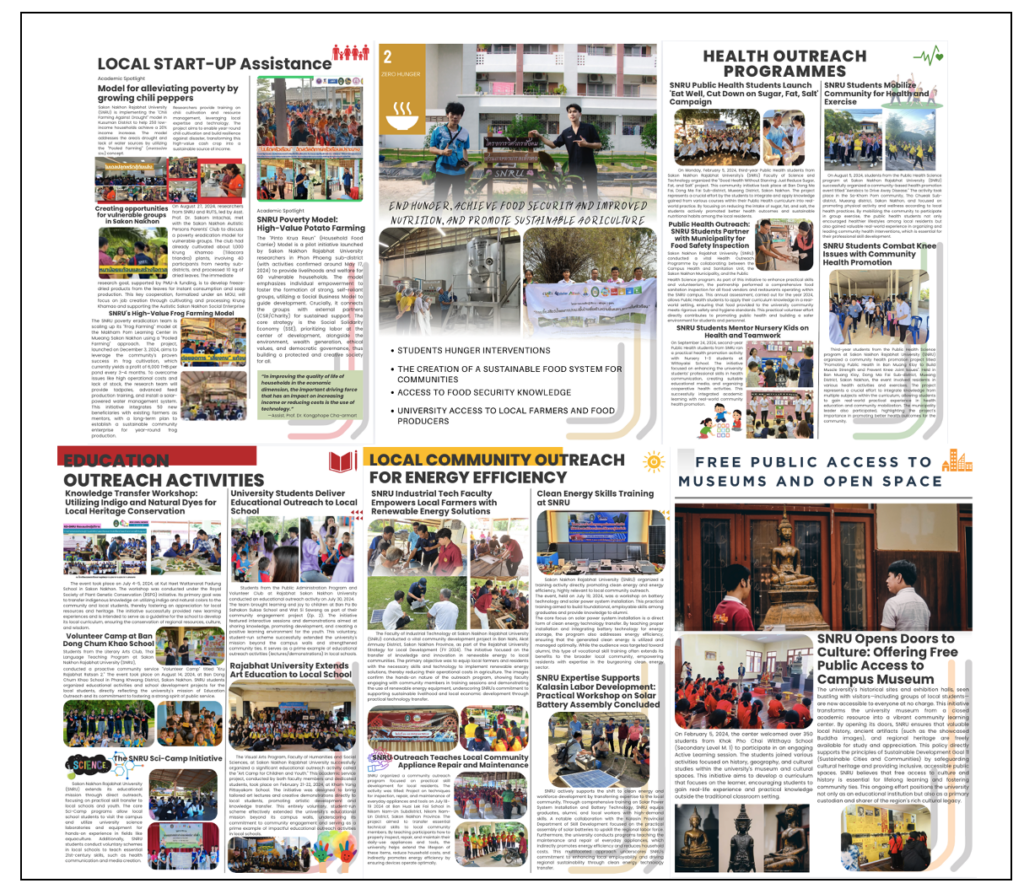
SDG 1: No Poverty – Promoted through specialized local startup assistance, implementing poverty alleviation models such as high-value frog farming, potato farming, and chili pepper cultivation to enhance the household income of vulnerable groups.
SDG 2: Zero Hunger – Supported via active student hunger interventions, community access to food security knowledge, and direct agricultural technology transfer to empower local food producers.
SDG 3: Good Health and Well-being – Driven by public health outreach programs, including student-led community fitness mobilization, health education, and local food safety inspections in collaboration with municipalities.
SDG 4: Quality Education – Delivered through extensive community and school outreach, including the SNRU Sci-Camp initiatives, arts education workshops, and knowledge transfer seminars for local heritage preservation.
SDG 7: Affordable and Clean Energy – Spearheaded by the Faculty of Industrial Technology through practical community outreach, delivering clean energy skills training and renewable energy solutions (such as solar power systems) to local farmers.
SDG 11: Sustainable Cities and Communities – Executed via institutional policies that grant free public access to campus museums, cultural exhibitions, and historical open spaces, safeguarding local heritage and fostering lifelong learning.
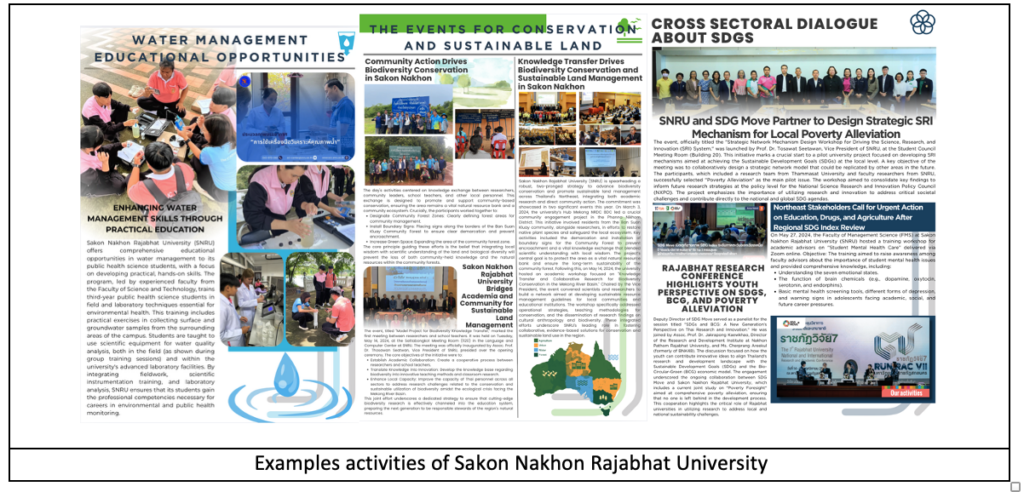
SDG 6Water Management & Sanitation– Demonstrated by the “Water Management Educational Opportunities” initiatives, where the university provides extensive practical, hands-on training to public health science students in environmental health. Programs involve rigorous fieldwork, laboratory techniques, and scientific instrumentation training to analyze surface and groundwater samples from surrounding areas, preparing the next generation of professional environmental monitors.
SDG 15Conservation & Sustainable Land Management– Driven by “The Events for Conservation and Sustainable Land Management” programs in Sakon Nakhon. The university bridges academia and regional communities through initiatives such as designating community forest zones, boundary-marking to prevent encroachment, expanding green spaces, and transferring knowledge on biodiversity preservation in the Mekong River Basin to ensure long-term ecosystem sustainability.
SDG 1, 17Cross-Sectoral Partnerships & Poverty Alleviation – Spearheaded through the “Cross Sectoral Dialogue About SDGs” framework. The university actively leads high-level strategic network workshops—collaborating with national policy councils, other academic institutions, and regional stakeholders—to design innovative science, research, and innovation (SRI) mechanisms specifically aimed at driving local poverty alleviation and tracking regional SDG indices.
This comprehensive integration across faculties confirms that SNRU’s Education and Research (ED) programs maintain a measurable, multi-dimensional impact firmly within the 10 SDGs bracket.
Academic Year Faculty/Department Total Graduates Graduates with Green Jobs Description of Green Jobs Data Source 2023 Faculty of Science and Technology 214 42 Government/Private Sector Jobs in Public Health/ Maintenance Technician, Related Factory Jobs File Analysis 2024 Faculty of Science and Technology 134 23 Government/Private Sector Jobs in Biology/ System Technician (Electrical/AC) File Analysis 2025 […]
Academic Year Faculty/Department Total Graduates 2023 Faculty of Education 562 2023 Faculty of Science and Technology 214 2023 Faculty of Management Science 500 2023 Faculty of Humanities and Social Sciences 350 2023 Faculty of Agricultural Technology 86 2023 Faculty of Industrial Technology 131 2024 Faculty of Education 526 2024 Faculty of Science and Technology 134 […]
Infographic provided figure, here is a comprehensive description of the personnel data on campus as of 23 June 2025: Campus Personnel Overview The institution houses a total workforce of 926 people. This workforce is structurally divided into two primary divisions: Detailed Analysis of the Academic Line Within the Academic Line (435 people), personnel are further […]