Based on the comprehensive portfolio compiled for the UI GreenMetric Questionnaire (Education & Research – ED.8), Sakon Nakhon Rajabhat University (SNRU) drives an extensive array of community service initiatives that actively integrate student participation with localized sustainable development.
Here is the strategic English overview of SNRU’s sustainability-focused community outreach programs, structured into five core thematic pillars:
These initiatives target grassroots economic resilience, food security, and modernizing agricultural frameworks across local sub-districts.
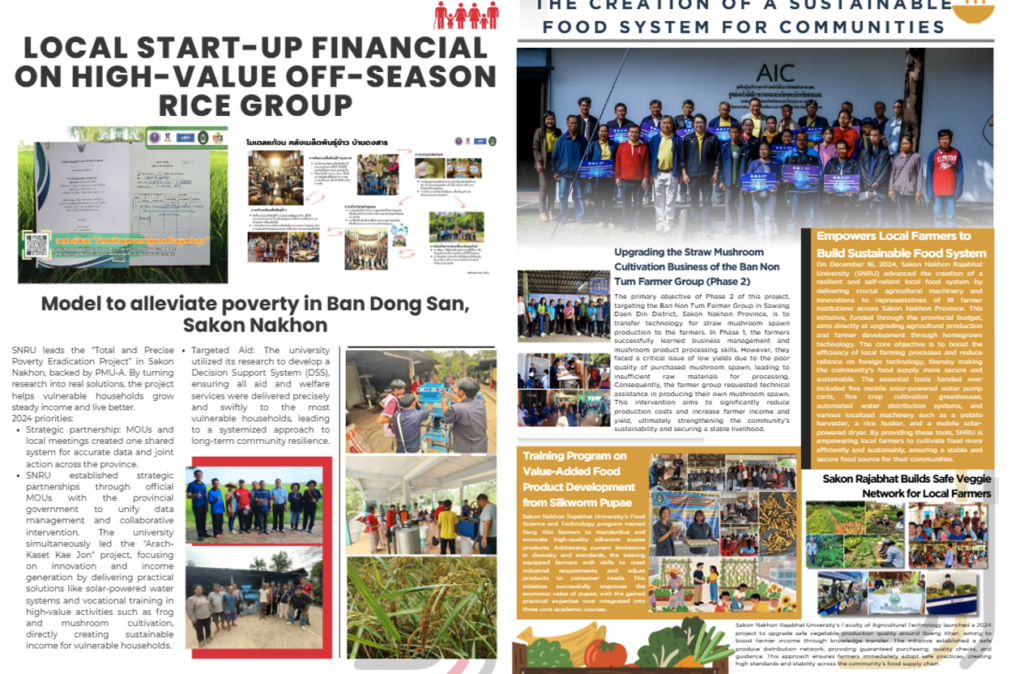
Poverty Eradication & Start-Up Funding: Under the Total and Precise Poverty Eradication Project (backed by PMU-A), students and researchers deployed a Decision Support System (DSS) in Ban Dong San to deliver precision aid. This includes launching high-value off-season rice groups, solar-powered water systems, and vocational training in frog and mushroom cultivation to stabilize vulnerable household incomes.
Resilient Food Systems: The university advanced a resilient community food supply by upgrading the straw mushroom cultivation business of the Ban Non Tum Farmer Group and building a Safe Veggie Network for local growers to ensure standardizing quality checks and guaranteed purchasing.
Nutritional Value-Adding: Students from the Food Science and Technology program conducted practical training to standardize and develop high-value commercial food products from silkworm pupae, integrating the expertise directly back into three academic courses.
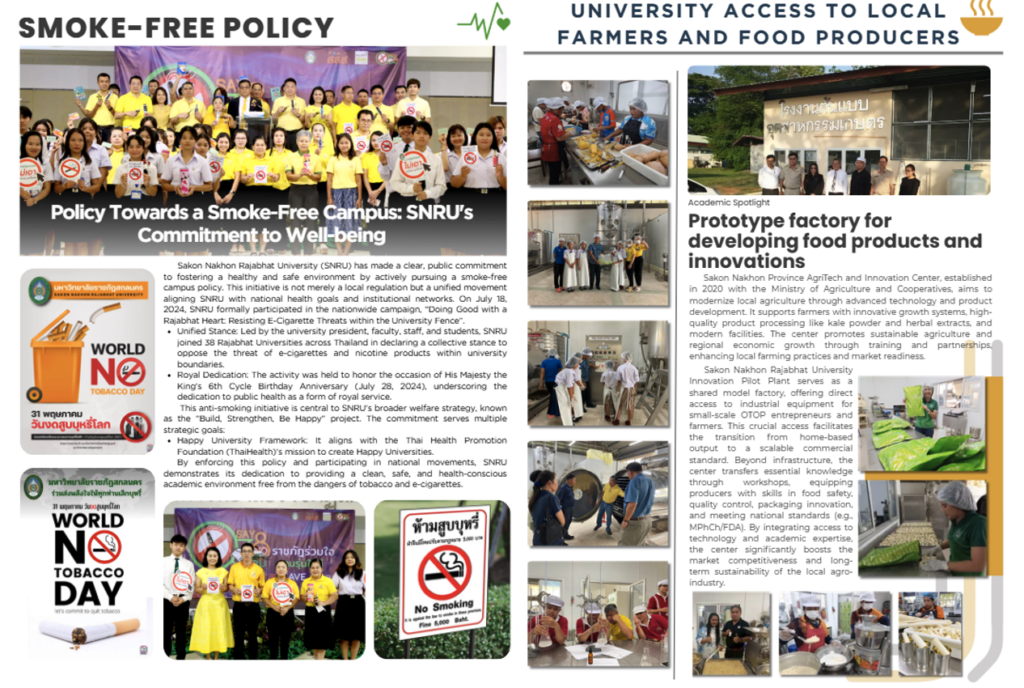
Industrial Infrastructure Sharing: The SNRU Innovation Pilot Plant and the AgriTech and Innovation Center function as open-access factories where local OTOP entrepreneurs and farmers utilize advanced industrial equipment to scale home-based products to commercial standards.
2. Renewable Energy Transfer & Technological Empowerment
Led predominantly by the Faculty of Industrial Technology, these student-involved programs build local capacities in clean energy and technical autonomy.
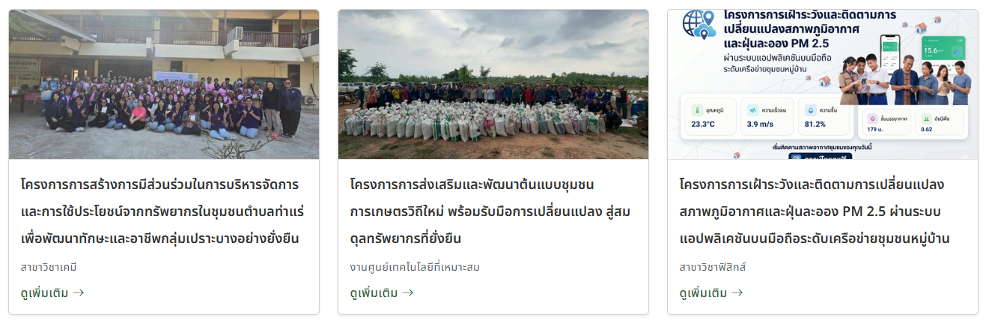
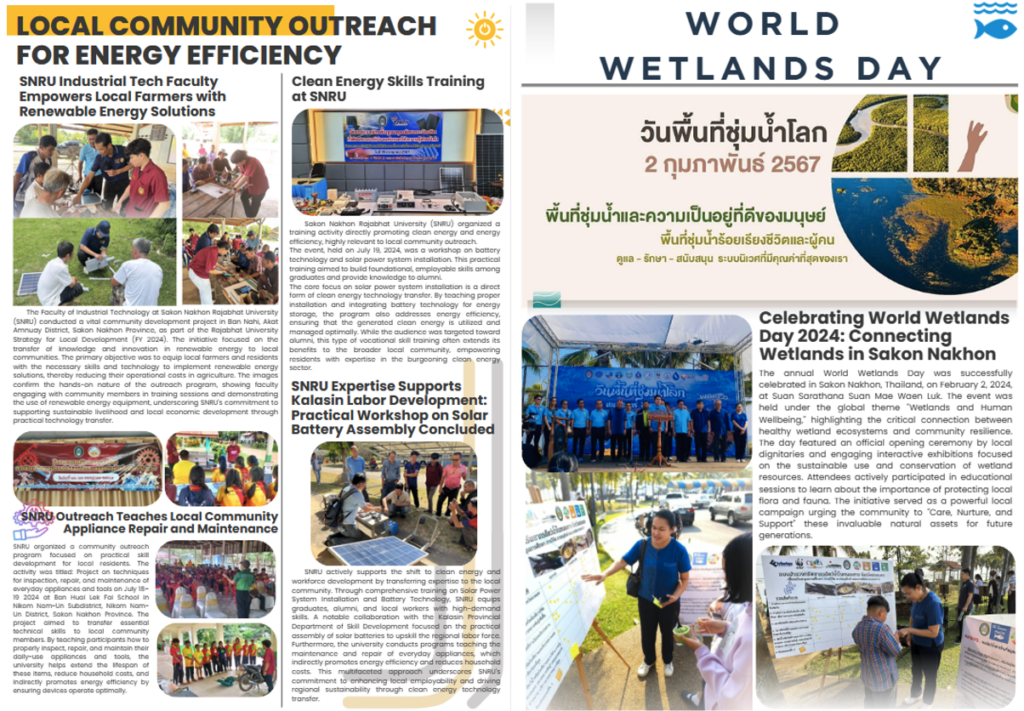
Solar Solutions for Farmers: Students deployed an on-field community development project in Ban Nahi to equip farmers with the skills to operate, repair, and maintain solar-powered agricultural equipment, mitigating farming overheads.
Clean Energy & Battery Workshops: Collaborative training camps on solar power system installations and battery technologies were conducted for alumni and regional laborers—notably partnering with the Kalasin Provincial Department of Skill Development to assemble solar batteries.
Resource Efficiency & Tool Maintenance: Practical outreach camps teach rural residents appliance repair and maintenance techniques, effectively doubling the lifespan of household devices while lowering consumer waste and optimizing home energy efficiency.
These projects translate environmental data into actionable civic management, directly mapping onto ecosystem and climate resilience goals.
Mobile Environmental Monitoring: Physics students engineered and distributed a mobile application network among village clusters to execute localized tracking of climate shifts and $PM_{2.5}$ dust particulate levels.
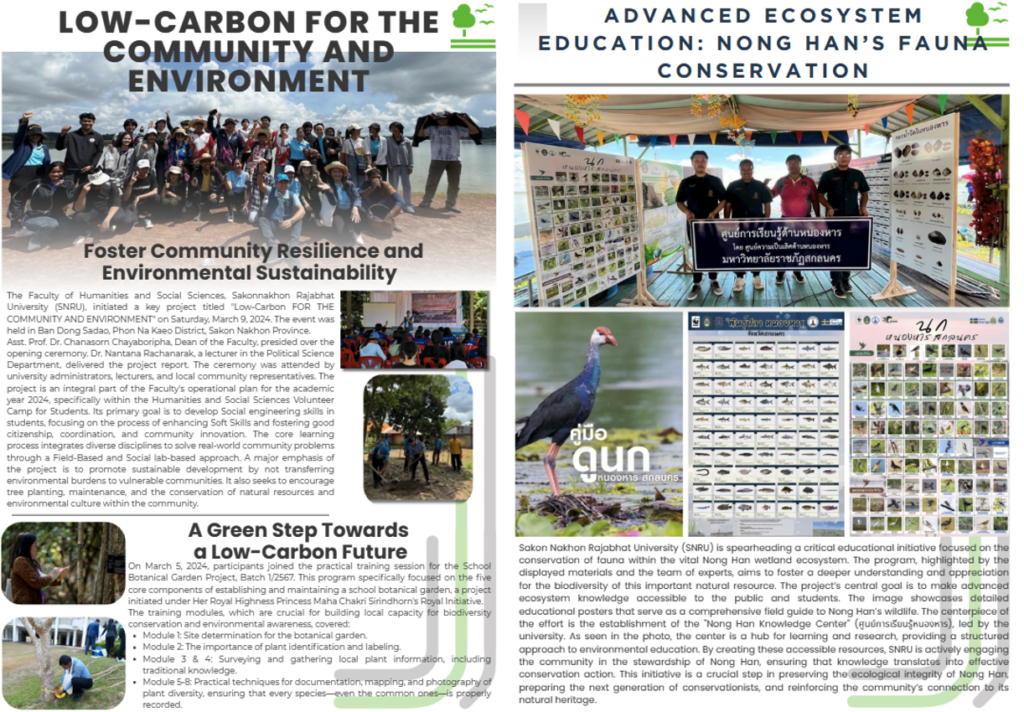
Low-Carbon Community Models: The Faculty of Humanities and Social Sciences established a student-run volunteer camp in Ban Dong Sadao focused on transferring “Social Engineering” soft skills to co-create community-led greenhouse gas mitigation and tree-planting strategies.
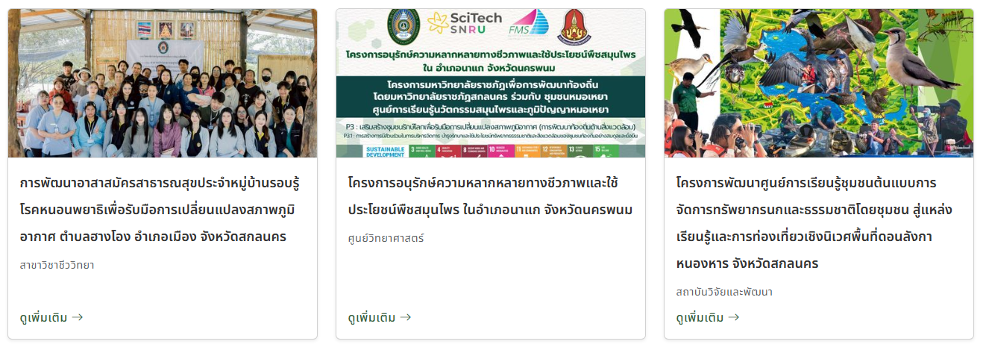
Botanical & Herb Conservation: Under the Royal Initiative of HRH Princess Maha Chakri Sirindhorn (RSPG), students led practical mapping, plant identification, and documentation of local medicinal herbs and biodiversity in Nakhon Phanom and Sakon Nakhon.
Wetland & Fauna Stewardship: In observance of World Wetlands Day, the university hosts public educational forums at the vital Nong Han wetland ecosystem. This includes establishing the Nong Han Knowledge Center, where student-led taxonomic field guides and posters enable public access to advanced ecosystem conservation knowledge.
4. Public Health Outreach & Community Well-being
Students across Public Health disciplines routinely extend classroom learning to address regional healthcare vulnerabilities and preventative wellness.
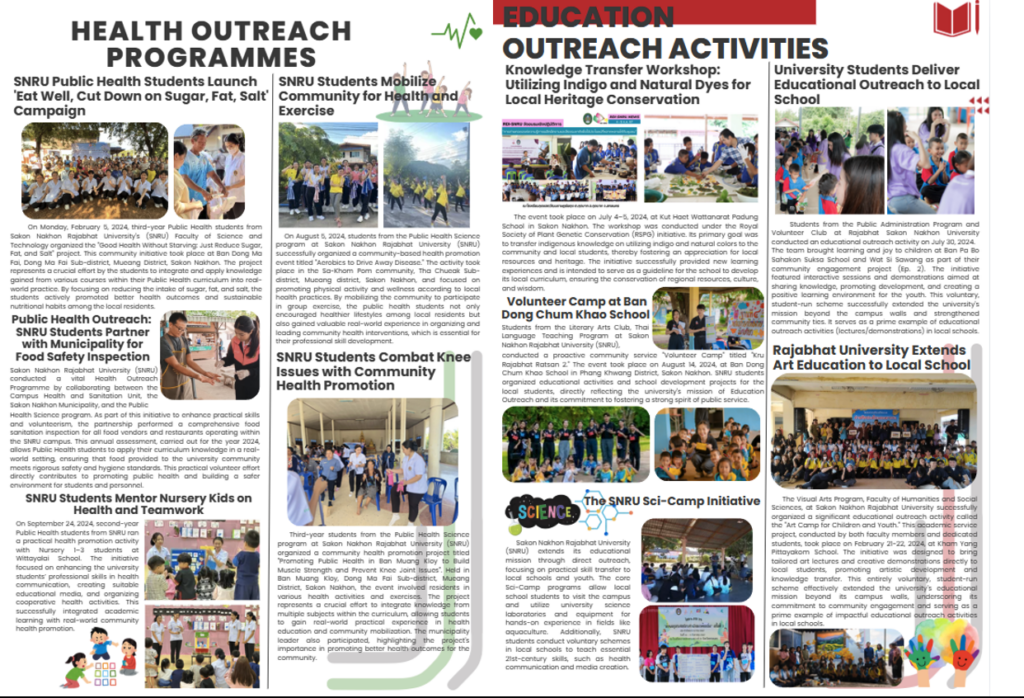
Nutritional & Lifestyle Interventions: Third-year public health students launched the “Eat Well, Cut Down on Sugar, Fat, Salt” campaign in Ban Dong Ma Fai to build long-term nutritional safety. Concurrently, student teams mobilized community-wide aerobic exercise drives to combat sedentary lifestyle diseases.
Climate-Induced Health Monitoring: Biology students established targeted local training to optimize village health volunteers’ ability to track and counter parasitic worm diseases linked closely with shifting regional climate patterns.
Food Safety Inspections: Partnering alongside the Campus Health and Sanitation Unit and municipal authorities, students conducted systematic hygiene audits across campus food vendors and neighborhood eateries.
Specialized Care Networks: Public health student groups ran physical therapy initiatives tackling knee-joint complications among elder residents in Ban Muang Klay, while others operated clinical communication and developmental workshops for early-childhood nursery centers.
5. Educational Quality, Art, & Local Heritage Conservation
These projects foster inclusivity and safeguard regional heritage via public school networks.
Indigo & Natural Dye Conservation: In alignment with regional heritage preservation, students ran knowledge-transfer workshops teaching local youth the science of extracting indigenous indigo and natural organic colors for sustainable textiles.
Student-Led Educational Camps: The Literary Arts Club and Visual Arts Program routinely organize volunteer field camps (such as Volunteer Camp at Ban Dong Chum Khao School and Art Camp for Children and Youth at Kham Yang Pittayakom School) to render quality arts and linguistic literacy accessible to rural schools.
The SNRU Sci-Camp Initiative: Open-door laboratory programs bring local school cohorts straight into university science facilities, providing them first-hand immersion in fields like aquaculture, media creation, and basic technology.
Students assist in surveying, building plant databases, photographing, and labeling local medicinal herbs and native flora to expand open-access green learning spaces.
2. Energy & Climate Change (EC)
EC.2 renewable energy
EC.6 greenhouse gas emission reduction programs
* Low-Carbon Knowledge Model Community Workshops (Kham Kha/Khram Phu Tai) * Solar-powered agricultural pump installation and maintenance projects
Industrial Technology students execute on-field knowledge transfers, training local farmers in solar battery assembly and calculating carbon emission reductions.
3. Waste (WS)
WS.1 waste recycling program
WS.2 organic waste treatment
* Student Dormitory Waste Segregation Initiative (4 standard bin types)
* Food scrap processing and organic waste composting in student dorm gardens
Students drive 100% of this program by separating waste at the source inside their rooms and transferring organic waste to be processed into fertilizer for campus agriculture.
4. Water (WR)
WR.1 water conservation program
WR.2 water pollution control
* On-Campus Water Quality Monitoring & Pollution Prevention Framework * Solar-Powered Community Water Systems and Irrigation Management
Science and Public Health students conduct regular water quality mapping, audit drainage lines to prevent pollution, and manage community water resource systems.
5. Transportation (TR)
TR.4 zero emission vehicles policy TR.6 pedestrian paths policy
* Student-led Green Campus & Green Office Awareness Campaigns
* Campus Car-Free Days & Air Pollution (PM2.5) Monitoring
Students act as “Social Engineers” to mobilize peers and community members, promoting eco-friendly habits, pedestrian safety, and pollution reduction.
6. Education & Research
(ED)
ED.8 number of sustainability community services projects
* Mobile Public Health & Nutrition Outreach Programs
(Direct 100% Match for this metric) Students actively integrate academic knowledge into field-based community services to address local economic, environmental, and educational challenges.
Sakon Nakhon Rajabhat University (SNRU) demonstrates a structured, significant impact on the United Nations Sustainable Development Goals (SDGs) through its diverse portfolio of education, research, and community outreach programs. As documented in the university’s institutional reporting and performance showcases, the curriculum and academic initiatives directly support at least 6 to 7 distinct SDGs: This comprehensive […]
Academic Year Faculty/Department Total Graduates Graduates with Green Jobs Description of Green Jobs Data Source 2023 Faculty of Science and Technology 214 42 Government/Private Sector Jobs in Public Health/ Maintenance Technician, Related Factory Jobs File Analysis 2024 Faculty of Science and Technology 134 23 Government/Private Sector Jobs in Biology/ System Technician (Electrical/AC) File Analysis 2025 […]
Academic Year Faculty/Department Total Graduates 2023 Faculty of Education 562 2023 Faculty of Science and Technology 214 2023 Faculty of Management Science 500 2023 Faculty of Humanities and Social Sciences 350 2023 Faculty of Agricultural Technology 86 2023 Faculty of Industrial Technology 131 2024 Faculty of Education 526 2024 Faculty of Science and Technology 134 […]