Sakon Nakhon Rajabhat University (SNRU) is a university for local development and treats poverty eradication as central to its mission. Sakon Nakhon is a farming province facing high production costs, low crop prices, drought, and “skipped-generation” households, where children live with grandparents while parents work elsewhere. Almost half of households (49.91%) depend on farming, and 6.56% of people in the Northeast lived below the poverty line in 2024, above the national rate of 4.89% (NESDC, 2025). The University Council’s 2025 policy sets up an Educational Opportunity Program to reduce social inequality and calls for area-based research with local partners. Strategy 1 of the University Strategic Plan 2023–2027, “Sustainable Local Development through Research and Innovation,” has a direct indicator on the percentage of the province’s people lifted out of poverty. This page summarizes SNRU’s work on SDG 1 in 2025.
1.3.3 Low-income student support
Beyond financial aid, SNRU gives students from low-income families practical support with food and housing so that they can complete their studies.
- Food: The “Indie Vegetable Garden” works as a living food bank for students facing financial hardship. Under SNRU’s Policy on Food Quality, Sustainability, and Access on Campus (1 November 2024), single-dish meals in campus canteens cost no more than 30–35 baht, and students living in dormitories grow and sell pesticide-free vegetables and fish through the “SNRU Dorm Kids’ Farm.”
- Housing: SNRU runs three on-campus dormitories, Kan Kraw, Ratchaphruek, and Erawan. The cheapest rooms cost 3,000 baht per term, about 600 baht a month, so students from low-income families can live in good-quality housing on campus and save on travel.
1.3.4 Bottom financial quintile student support
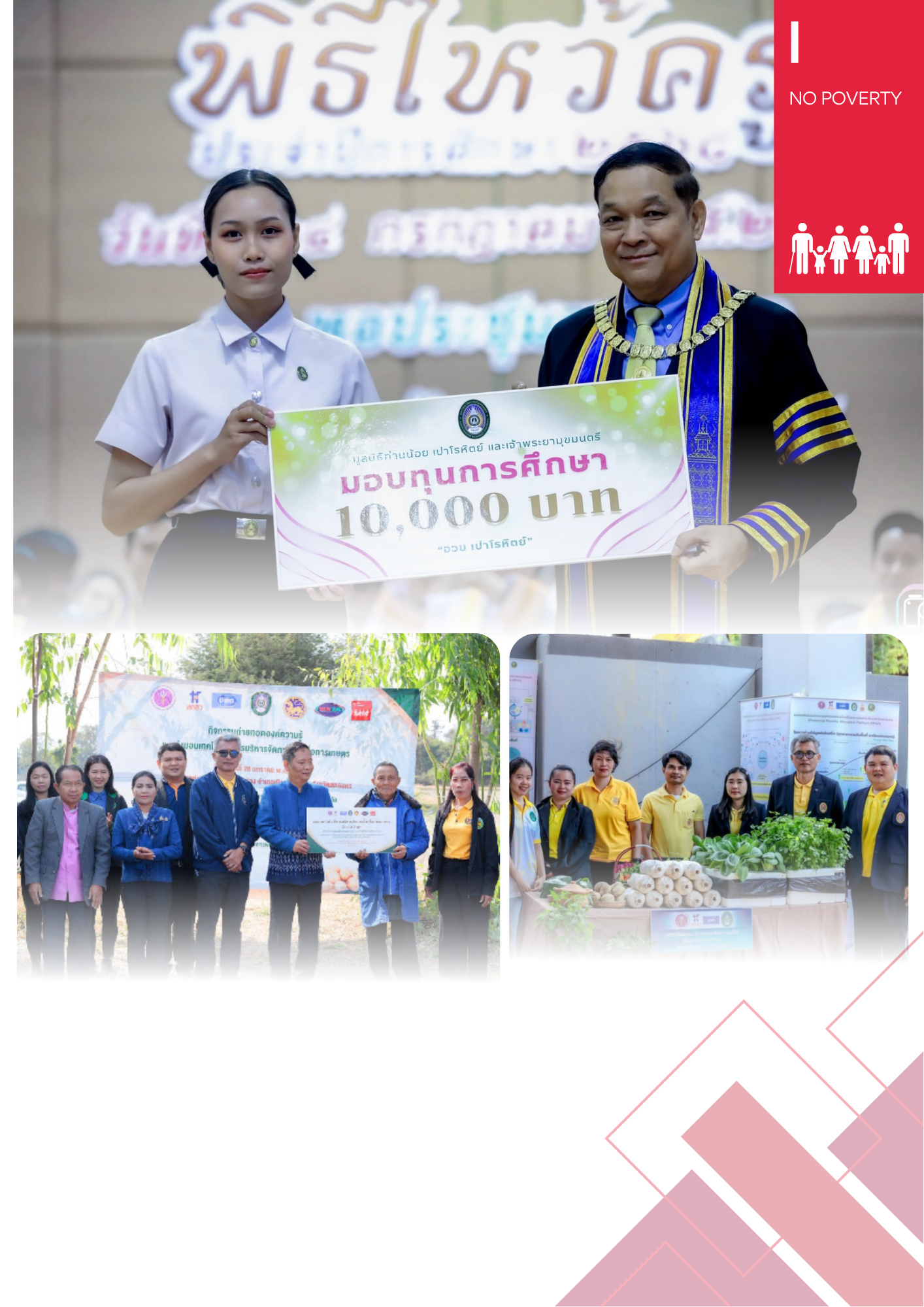
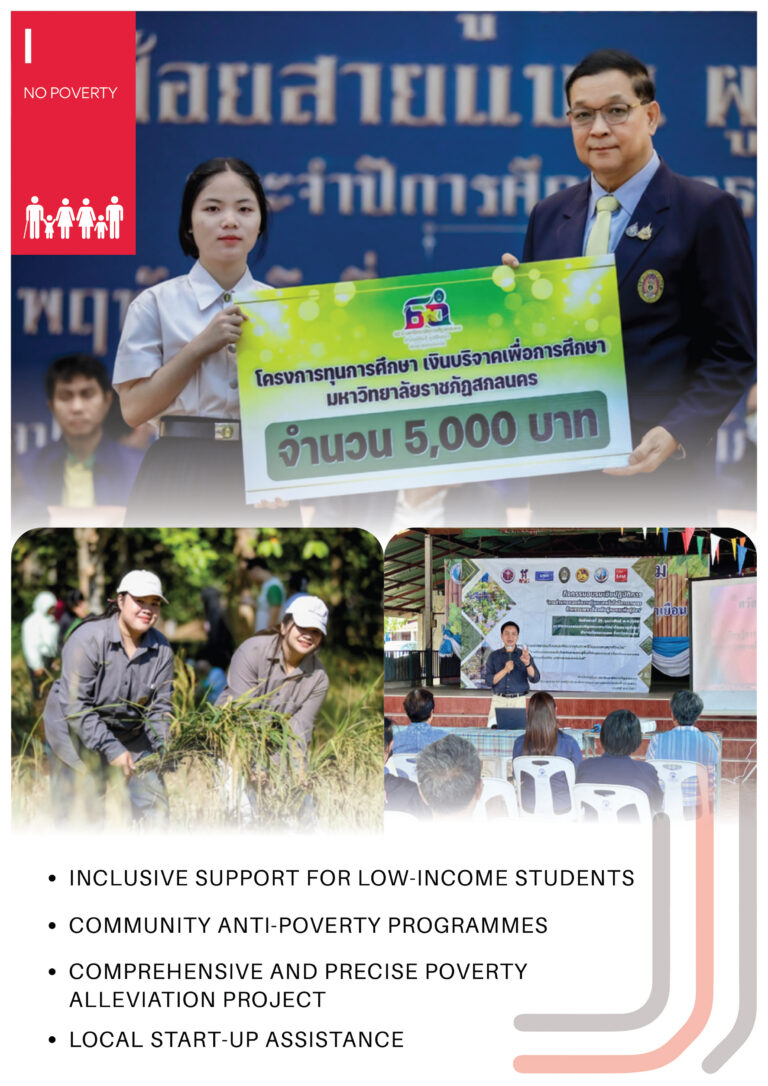
Many SNRU students come from farming families and low-income households in Sakon Nakhon, Nakhon Phanom, and Mukdahan. SNRU’s committed to ensuring that no capable student is kept out of higher education or forced to leave it because of family income. The Student Development Division runs two complementary support systems for students in financial need: the Student Loan Fund (SLF), including Type 1 loans for students from low-income families, and non-repayable scholarships from royal and private foundations, businesses, alumni, and SNRU’s own education donation fund. In the 2024 academic year, SNRU provided 3,468 financial support awards to students, totaling 169,217,400 baht. About 30% of undergraduates (2,423 students in 2024) borrow from the Student Loan Fund Type 1 for students in financial need, and 135 students received non-repayable scholarships, 76.30% of them women.
1.3.5 Low- or lower-middle-income countries’ student support
Each year, 24–26 students from Lao PDR, a lower-middle-income country, study for master’s and doctoral degrees at SNRU’s Graduate School. Most receive tuition fee reductions of 40–70%, which allow them to study in Thailand and return to work in their home country.
1.4.1 Local start-up assistance
SNRU provides training, technology, and mentoring to help local people start and grow financially and socially sustainable community businesses. In 2025:
- Straw mushroom community enterprise, Ban Non Tum, Sawang Daen Din District (Phase 3): The Agribusiness Program helped individual farmers become a community enterprise with a network for joint production and marketing, trained them to produce their own spawn, and combined field and mushroom-house cultivation so they can harvest year-round.
- Silkworm pupae food products, Sang Kho: The Food Science and Technology Program trained silkworm farmer groups at the SNRU Food Product and Innovation Pilot Plant to develop new food products that meet production standards and buyer needs.
- Herbal compress balls, Phon Na Kaeo Organic Agriculture Community Enterprise: The Faculty of Industrial Technology transferred technology to upgrade processing, raising product quality and household income.
- Potato value chain, Ban Khok Kong (28 January 2025): SNRU linked more than 200 low-income households to a commercial potato supply chain with Wata Thai Trading Co., Ltd., which buys the crop and hires local people, aiming to raise household income by 20%.
- Climbing perch farming, Ban Tham Si Kaeo (24–25 June 2025): A hands-on workshop helped villagers move from relying on wild fish to farming climbing perch for home use and sale.
1.4.3 Programs for service access
Since 2020, SNRU has led the Sakon Nakhon Total and Precise Poverty Eradication Platform, funded by the Program Management Unit on Area-Based Development (PMU-A). The platform identifies poor households and connects them to basic services. Over five years, 45 agencies signed MOUs; a database of 12,545 households was built; 1,356 people received direct help with welfare, health, housing, and skills; and 2,392 households in 7 districts received livelihood support. 29.81% of poor households in the target areas moved out of poverty (2020–2024), and participating households’ income rose by 20% on average. SNRU also trained 54 area managers and local volunteers to use household poverty data, and comparing national TPMAP data with field surveys identified poor people who had been missed, improving targeting of assistance.
1.4.4 Policy addressing poverty
Local level. SNRU has worked with the Akat Amnuai district office since 2022 to design a “Poverty-Solving District” model, analyzing each household’s livelihood assets to plan a livelihood strategy for each subdistrict (presented 30 May 2025). Its three-year MOU (2024–2026) with the ABC Poverty Alleviation Center, Kut Bak Phatthana Suksa School and the Phu Phan Royal Development Study Center supports joint work to reduce poverty in Kut Bak District. On 27 February 2025, SNRU convened district, provincial, and local agencies and a private buyer to plan potato farming as a poverty-reduction tool, with commitments from each partner.
Provincial and regional level. On 27 April 2025, ahead of the mobile Cabinet meeting for Nakhon Phanom, Sakon Nakhon, and Mukdahan, SNRU led three universities in presenting five years of poverty platform results to the Minister of Higher Education, Science, Research, and Innovation. On 12 November 2025, SNRU and 12 provincial agencies agreed to build a provincial poverty data center (SNOMAP), a targeted referral system, and pilot poverty-free areas. On 21 November 2025, the Governor of Sakon Nakhon directed that the platform serve as the basis for future provincial poverty-reduction policy and set up a multi-agency working group to oversee it. In December 2025, SNRU produced strategic proposals for the province and joined 10 other Northeast institutions in the “Data Power” learning community on using poverty data.
National level. In June 2025, SNRU worked with SDG Move (Thammasat University) to design a national research mechanism for local poverty alleviation, whose findings inform the research policy of the Office of National Higher Education Science Research and Innovation Policy Council (NXPO). On 7–8 June 2025, SNRU led a team at the national PMU-A poverty platform conference, where researchers from 20 provinces planned joint work. By 2024, SNRU’s projects had been written into 6 subdistrict and 2 district development plans, as well as the plan of the Phu Phan Royal Development Study Center.
Full report: SNRU SDGs Report 2025, SDG 1 No Poverty (pages 14–23).
Post Views: 103