Sakon Nakhon Rajabhat University (SNRU) defines itself as “a higher education institution for local development,” so partnership is central to its mission. The University Council approved the 5-Year Strategic Plan (2026–2030) on 4 July 2025, with the vision “A Leading Higher Education Institution for Local Development with Global Perspectives through Innovation, Wisdom, and Good Governance.” A Vice President for Planning, Strategy, Innovation, and Global Engagement oversees this work, and the Global Engagement and University Rankings Unit builds and monitors partnerships in Thailand and abroad. SNRU has appointed chairs and representatives for all 17 SDGs and publishes the SNRU SDGs Report every year. This page summarizes SNRU’s partnerships for the SDGs in 2025.
17.2.1 Relationships with regional NGOs and government for SDG policy
National research policy (18 June 2025). SNRU and the SDG Move Center at Thammasat University held a workshop to design a strategic network mechanism so that Thailand’s science, research, and innovation (SRI) system can help achieve the SDGs at the local level. Participants chose poverty alleviation as the pilot issue, and the findings are being developed into policy recommendations for the research strategy of the Office of National Higher Education Science Research and Innovation Policy Council (NXPO). SNRU and SDG Move are also conducting a joint “Poverty Foresight” study.
Provincial SDG Index for the Northeast (26 February 2025). With the SDG Move Center and Chulalongkorn University’s Social Research Institute, SNRU hosted the “Area Need 3” forum for more than 60 participants from government, academia, the private sector, and civil society. The forum presented a preliminary provincial SDG Index, identified nine at-risk goals in the Northeast, and started a regional effort to use the index as a planning tool.
Provincial poverty policy. Since 2020, SNRU has led the Sakon Nakhon Total and Precise Poverty Eradication Platform. On 27 April 2025, SNRU led three universities in presenting five years of results to the Minister of Higher Education, Science, Research, and Innovation. On 21 November 2025, the Governor of Sakon Nakhon directed that the platform serve as the basis for future provincial poverty-reduction policy and set up a multi-agency working group to oversee it. By 2024, SNRU’s projects had been written into 6 subdistrict and 2 district development plans and the plan of the Phu Phan Royal Development Study Center.
17.2.2 Cross-sectoral dialogue about SDGs
“Live in Sakon, Love Sakon, Work for Sakon Nakhon” forum (21 August 2025). SNRU and 11 other educational agencies hosted the province’s 8th monthly cross-sector forum of 2025 at Jamjuree 1 Auditorium. The Governor of Sakon Nakhon opened the event, which brought together deputy governors, heads of government agencies, the private sector, local government executives, and civil society to exchange views on sustainable provincial development.
Community organization forum (8 December 2025). SNRU’s poverty-reduction research team, the Sakon Nakhon Community Organization Network, and the Community Organizations Development Institute (CODI), Northeast region, held a forum at SNRU with government agencies and civil society groups to review 2025 and plan poverty reduction for 2026. As a result, the Provincial Community Organizations Council invited SNRU’s researchers to serve on its expert committee for 2026 projects.
Low-carbon creative economy (14 August 2025). SNRU’s Carbon Neutrality Center signed cooperation agreements with the Sakon Nakhon Provincial Office of Natural Resources and Environment, the Sakon Nakhon Office of SME Promotion, and the Sakon Nakhon Tourism Industry Council and hosted a panel on low-carbon tourism for businesses, community enterprises, students, and the public.
17.2.3 International collaboration data gathering for SDG
Nong Han wetland bird survey with Vietnam (24 November 2025). SNRU’s Research and Development Institute, the University of Education—The University of Danang (Vietnam), government agencies, civil society, and the Sakon Nakhon Bird Conservation Club carried out a joint field survey of waterbirds in the Nong Han wetland. The team recorded a flock of more than 300 Glossy Ibis at Don Hin, a sight rarely seen in Thailand. The data measure the wetland’s health and biodiversity (SDG 14 and SDG 15) and support the shared goal of designating Nong Han a Wetland of International Importance under the Ramsar Convention.
Renewable energy research with Indonesia and Japan. On 21 July 2025, SNRU’s Center of Excellence on Alternative Energy welcomed researchers and students from Institut Teknologi Sepuluh Nopember (ITS), Indonesia, under its Visiting Researcher Program. The partnership grew out of the e-ASIA joint research program between SNRU, ITS, and Kanazawa University, Japan, which began in 2018. Since then, 21 ITS students have synthesized and tested thermoelectric materials at SNRU, and the two institutions co-authored eight publications between 2020 and 2025 (SDG 7).
17.2.4 Collaboration for SDG best practice
Sharing SNRU’s poverty-reduction model (7–8 June 2025). SNRU’s poverty platform team, with Rajamangala University of Technology Isan, Sakon Nakhon Campus, presented Sakon Nakhon’s poverty-reduction work as a model at a national conference of the Program Management Unit on Area-Based Development and exchanged practices with researchers from 20 provinces on poverty platforms, professional learning communities, and partnership building. On 13 December 2025, SNRU joined 10 other institutions in the Northeast in the “Data Power” professional learning community on using poverty data and will host its next forum.
Adopting best practice in laboratory safety (13 June 2025). SNRU and Khon Kaen University’s Research Center for Environmental and Hazardous Substance Management held a workshop on the ESPReL Checklist, a national laboratory safety assessment tool, to bring the host university’s best practices into SNRU’s laboratories.
Community cultural work (7 June 2025). SNRU’s Institute of Language, Arts, and Culture visited the Pattaya City Cultural Council to exchange approaches to managing and sustaining local culture with young people and will adapt these practices in Sakon Nakhon.
17.2.5 Collaboration with NGOs for SDGs
MOU with the Isan Local Development Research Institute Foundation (26 June 2025). SNRU signed a memorandum of understanding on “Advancing Research and Academic Services for Local Development” with this non-profit foundation. The partnership combines the foundation’s community experience with SNRU’s research to help Isan communities tackle poverty and inequality themselves (SDG 1, SDG 10). Speakers from the foundation also trained SNRU staff in area-based community work on 4–6 August 2025.
Other NGO partners in 2025. SNRU works with WWF Thailand on forums to conserve the Nong Han wetland, with the Stockholm Environment Institute at World Wetlands Day 2025, and with the Sakon Nakhon Bird Conservation Club on wetland bird surveys.
17.3 Publication of SDG reports
SNRU publishes the SNRU SDGs Report every year. The 2025 report includes a dedicated chapter for each of the 17 SDGs, outlining the university’s policy and commitment, as well as its key activities and projects for each goal.
17.4.1 Education for SDGs: commitment to meaningful education
SNRU follows an educational philosophy of “outcome-based education in which learners apply knowledge in practice to develop their local communities creatively.” Its “Social Engineer” plan links four levels: policy, curriculum, student activities, and community fieldwork in Living Labs. Learning outcomes from the U-SEAL framework (University Social Engagement & Active Learning) are integrated into every program so that all students develop public-mindedness, understand communities, and can create innovations for sustainable local development. In the 2024 academic year, this applied to 68 programs and 8,990 undergraduate and graduate students.
17.4.2 Education for SDGs: specific courses on sustainability
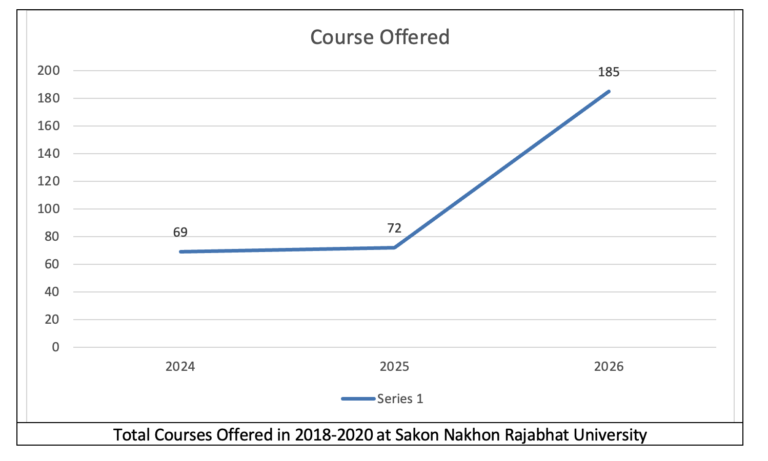
In 2025, SNRU offered 72 courses related to the environment and sustainability, such as Principles of Environmental Science, Environmental Ecology, Renewable Energy Technology, Industrial Energy Conservation, Sustainable Tourism, and the Sufficiency Economy Way of Life. SNRU also offers a B.Sc. in Environmental Science and energy-related degrees from bachelor’s to doctoral level.
17.4.3 Education for SDGs in the wider community
SNRU runs SDG education for communities, schools and the public. In 2025, it held a workshop on “Upgrading Model Communities for Beef Cattle Farming” at the Ban Khaem Phung Beef Cattle Farmers Community Enterprise (24 July), a “Community Knowledge Management” workshop at Ban Tha Wat (20–23 July), and “STREAM Education with Sawdust Modeling Clay” with Sawang Daen Din School, using local agricultural waste (August). The Environmental Science program trained two community enterprises in Rai Subdistrict, Phanna Nikhom District, to cut greenhouse gas emissions and calculate product carbon footprints (8 and 26 December), and the Center of Atmospheric and Space Science trained students of Sakon Nakhon Phatthana Suksa School to monitor PM2.5 and climate with a mobile app (2 December).
Full report: SNRU SDGs Report 2025, SDG 17 Partnerships for the Goals (pages 107–114).