This executive summary outlines the scale, proportion, and strategic alignment of sustainability-related education at Sakon Nakhon Rajabhat University for the current academic year. These metrics serve as the official data baseline for the UI GreenMetric World University Rankings (Criterion 6: Education and Research).
## 2. Key Performance Indicators (KPIs)
Total Sustainability Courses Offered [6.1]:185 unique courses
Total Institutional Courses Offered [6.2]:4,652 courses
Semester 1 Base: 2,827 courses
Semester 2 Base: 1,825 courses
Sustainability Education Proportion:3.98% of the total institutional curriculum directly integrates sustainability themes.
## 3. Curricular Distribution & Core Themes
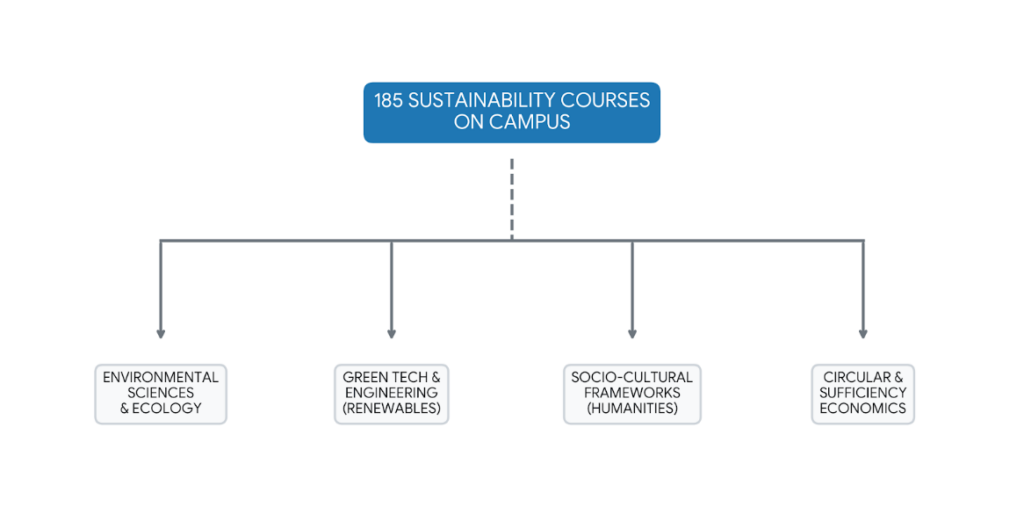
The 185 sustainability-focused courses identified across the university’s regular undergraduate curriculum (as verified in the academic records and image_d5f4c8.png) are strategically balanced across four primary pillars:
Environmental Sciences & Pollution Control: Courses such as Principles of Environmental Science and Environmental Ecology provide core scientific competencies in resource preservation.
Green Technology & Renewable Energy: Courses like Renewable Energy Technology and Industrial Energy Conservation drive technical engineering solutions.
Socio-Cultural Frameworks & Ecotourism: Programs like Social Engineers and Sakon Nakhon Basin Culture and Sustainable Tourism embed local identity and civic responsibility.
Circular & Sufficiency Economics: Core subjects like Living Through 21st Century Circular Economy Concepts and Sufficiency Economy Way of Life deliver green business and economic modeling skills.
## 4. Strategic Growth Trend
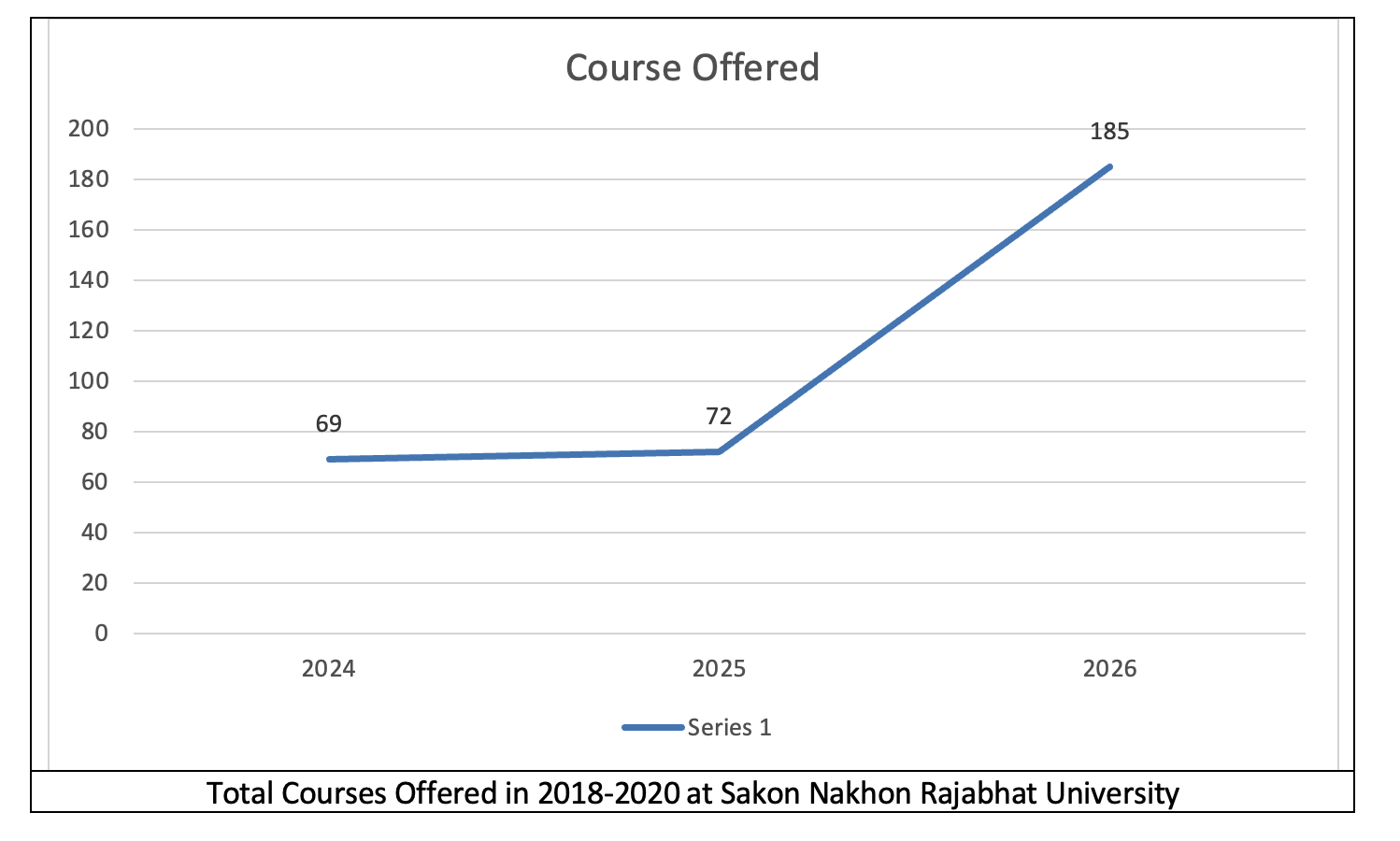
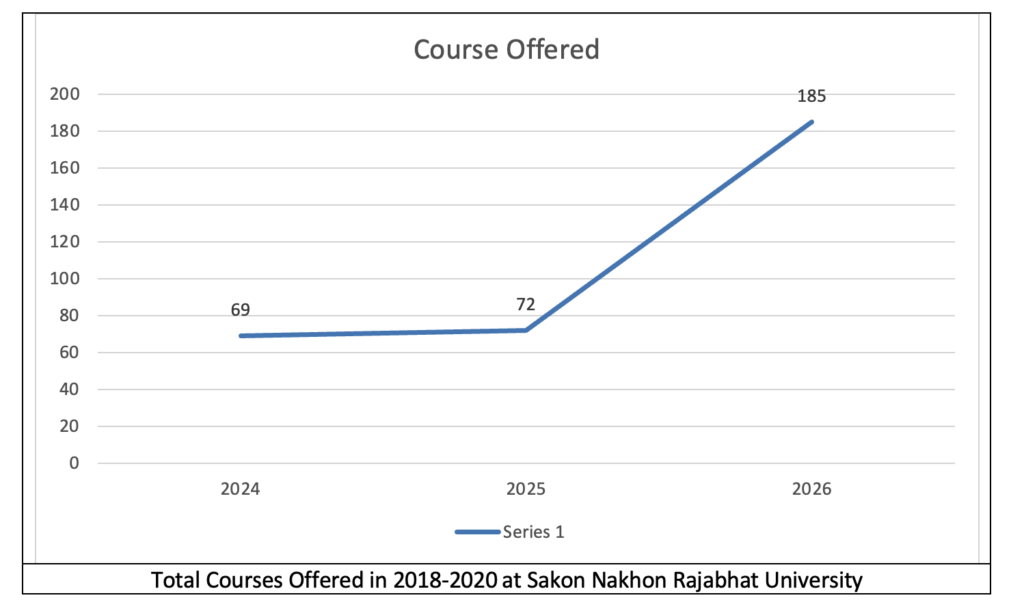
As illustrated in our longitudinal tracking chart (image_d5f4c8.png), the university has experienced a notable expansion in its dedicated green curriculum:
2024 Baseline: 69 courses
2025 Progress: 72 courses
2026 Reporting Cycle:185 courses
This growth reflects the university’s intentional policy to explicitly embed environmental, social, and economic sustainability benchmarks into Course Learning Outcomes (CLOs) across all active faculties.
## 5. Conclusion & Institutional Commitment
The data confirms that Sakon Nakhon Rajabhat University is successfully shifting from isolated environmental courses to an integrated, campus-wide green curriculum model. With 4,652 active course offerings providing a strong denominator, the university possesses the institutional capacity to continue expanding its sustainability curriculum footprint in upcoming academic cycles.
Total number of courses offered in 2026 = 185 courses (not modules)
Sakon Nakhon Rajabhat University (SNRU) demonstrates a structured, significant impact on the United Nations Sustainable Development Goals (SDGs) through its diverse portfolio of education, research, and community outreach programs. As documented in the university’s institutional reporting and performance showcases, the curriculum and academic initiatives directly support at least 6 to 7 distinct SDGs: This comprehensive […]
Academic Year Faculty/Department Total Graduates Graduates with Green Jobs Description of Green Jobs Data Source 2023 Faculty of Science and Technology 214 42 Government/Private Sector Jobs in Public Health/ Maintenance Technician, Related Factory Jobs File Analysis 2024 Faculty of Science and Technology 134 23 Government/Private Sector Jobs in Biology/ System Technician (Electrical/AC) File Analysis 2025 […]
Academic Year Faculty/Department Total Graduates 2023 Faculty of Education 562 2023 Faculty of Science and Technology 214 2023 Faculty of Management Science 500 2023 Faculty of Humanities and Social Sciences 350 2023 Faculty of Agricultural Technology 86 2023 Faculty of Industrial Technology 131 2024 Faculty of Education 526 2024 Faculty of Science and Technology 134 […]