Sakon Nakhon Rajabhat University (SNRU) is committed to ending hunger and building food security for its students and staff and for the farming communities of Sakon Nakhon, where almost half of all households depend on agriculture. On campus, SNRU’s Policy on Food Quality, Sustainability and Access on Campus (1 November 2024) sets standards so that every food and beverage service is safe, nutritious and affordable. Beyond campus, the Faculty of Agricultural Technology and the Research and Development Institute transfer knowledge and technology to smallholder farmers. This page summarizes SNRU’s work on SDG 2 in 2025.
2.2.1 Campus food waste tracking
SNRU measures the food waste generated across the whole university. Its work is guided by the Policy on Landfill Disposal, Recycling and Waste Management Practices and the Policy on Food Quality, Sustainability and Access on Campus, which cover every canteen, food outlet, catering service and vending machine on campus. In 2025, the campus generated 75 tonnes of food waste, down from 81 tonnes in 2024, a reduction of 7.4%. Of this, 6 tonnes were reused and 18 tonnes were treated and recycled. Following the 3R principles, SNRU runs waste-reduction campaigns in its canteens, places clearly labeled separation bins across campus, and turns organic waste into compost in a concrete compartment composting system that produces about 1.5–3 tonnes of compost a year.
2.3.1 Student food insecurity and hunger
Many SNRU students come from farming families and low-income households. SNRU addresses student food insecurity through its Policy on Food Quality, Sustainability and Access on Campus and through practical programmes on campus. The “Indie Vegetable Garden” works as a living food bank for students facing financial hardship, and dormitory farming gives residents easy access to fresh food at low cost.
2.3.2 Students hunger interventions
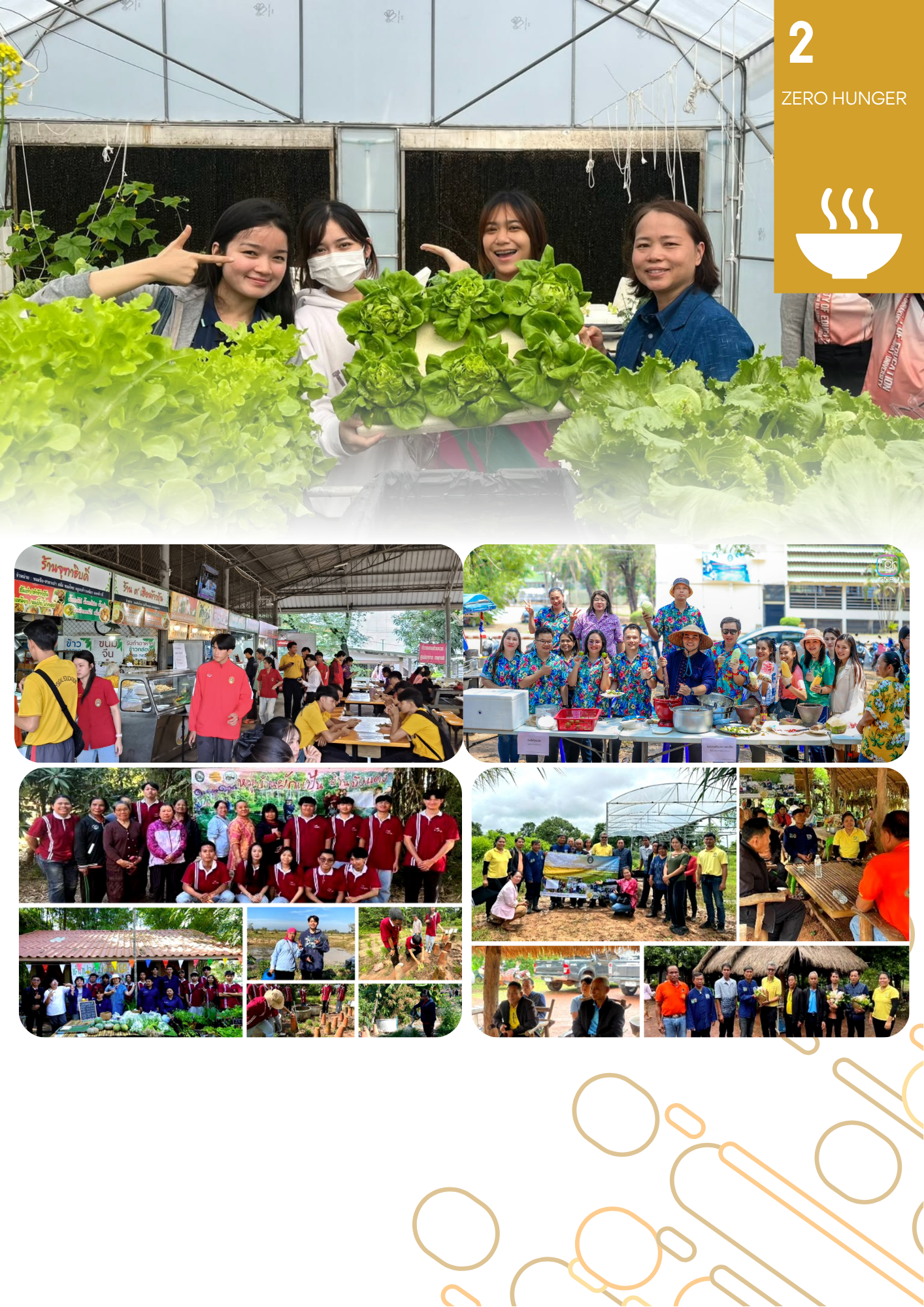
Indie Vegetable Garden food bank. The Plant Science program runs the Indie Vegetable Garden, which supplies fresh vegetables to students facing financial hardship.
“SNRU Dorm Kids’ Farm”. The Inner Dormitory Club at Kan Krao Dormitory turned unused land into pesticide-free vegetable beds and a fish pond in two months, on a 30,000-baht budget, as a Social Engineer project. Students grow morning glory, kale, bok choy, coriander, cucumber and chili, and sell the produce and fish to fellow students and staff at low prices, reinvesting the income in the next planting cycle.
2.3.3 Sustainable food choices on campus
Under SNRU’s food policy, campus vendors must offer nutritious options, including vegetable-based and healthy menu choices. The university promotes local, seasonal vegetables and fruit free of chemical residues from Sakon Nakhon farmers, from safe-vegetable networks supported by the Faculty of Agricultural Technology, and from campus gardens. Vendors are encouraged to cut down on foam and single-use plastics and choose environmentally friendly packaging. The Plant Science program and its students sell safe vegetables from university greenhouses to the campus community at low prices.
2.3.4 Healthy and affordable food choices
SNRU applies its food policy to its 3 canteens and 30 food outlets. Vendors must display clear prices, sell single-dish meals at no more than 30–35 baht, offer nutritious options, and pass food sanitation inspections, which the university carries out twice a year with its Health and Sanitation Unit, Public Health students and Sakon Nakhon Municipality. Vendors who break these conditions face penalties up to termination of their lease, and the Property and Revenue Section checks that prices match portion size and quality. Every Wednesday during the academic year, the “SNRU Market Day” brings an average of 10 farmers and food entrepreneurs to campus to sell fresh produce and meals at affordable prices.
2.3.5 Staff hunger interventions
Under the Policy on Food Quality, Sustainability and Access on Campus and the “Build, Strengthen, Be Happy” welfare project of the Happy University framework with ThaiHealth, faculties and offices set up food stalls each year and serve local dishes such as som tam, noodles and Thai desserts free to staff at every level, including civil servants, university employees, contract workers, cleaners and security guards. The event eases living costs, especially for lower-income staff. Staff can also buy affordable meals in campus canteens and safe vegetables and local food at fair prices at the weekly SNRU Market Day.
2.5.1 Access to food security knowledge
“Phak Tho Phu Thao” safe-vegetable network. The Plant Science program developed the Phak Tho Phu Thao group in Dan Muang Kham Subdistrict into a research-based model for safe vegetable production. In FY2025, the model was scaled up to Ban Bueng Daeng, Khok Kong Subdistrict (23 April 2025), where the group mentored new farmers and bought their produce at a guaranteed 30 baht/kg year-round, raising their income by 728 baht a month (+10.12%), and to Chiang Sue Subdistrict (16–17 and 19 July 2025), where farmers from three communities set up seven demonstration plots and raised their income by 5%.
Hom Dok Hang native rice. SNRU worked with the native rice conservation community enterprise of Ban Hom Dok Hang, Kusuman District, to make it a model community for producing native rice with innovation. Its 50 members learned through 3 learning stations and received a soil-improvement production kit and 3 new packaging designs; 90% put the knowledge into practice.
2.5.2 Events for local farmers and food producers
In 2025, SNRU ran events to transfer knowledge to farmers and food producers in Sakon Nakhon, including climbing perch farming at Ban Tham Si Kaeo (24–25 June 2025), cattle and buffalo health training at the Ban Pa Phang organic livestock enterprise (29–30 May 2025), straw mushroom spawn production at Ban Non Tum, food product development from silkworm pupae for farmer groups from Sang Kho, and the “Upgrading Model Communities for Beef Cattle Farming” workshop at Ban Khaem Phung (24 July 2025).
2.5.3 University access to local farmers and food producers
SNRU opens its laboratories, equipment, technology and breeding stock to local farmers, food producers, community enterprises and SMEs. In FY2025, the Faculty of Agricultural Technology ran 14 community service projects worth 3,565,430 baht. Farmers can use:
- Agro-Industry Pilot Plant: freeze-dryers, extraction units and standard packaging systems, with training for TCPS, GMP and FDA standards.
- Veterinary clinic and animal disease diagnostic center: blood tests, screening for emerging livestock diseases and milk-quality testing for network farms.
- Aquaculture Smart Farm: improved fish fry and broodstock, low-cost feed, water-treatment microbes and mobile breeding kits.
2.5.4 Sustainable food purchases
SNRU prioritizes safe, locally produced, and environmentally friendly food under its Policy on Food Quality, Sustainability, and Access on Campus (1 November 2024) and its Policy on Expanding Measures for Engaging External Suppliers (26 January 2023). Meat and eggs should come from certified, hygienic sources; fish from certified, legally operating sources; and vegetables and fruit should be local, seasonal and free of chemical residues, with priority for Sakon Nakhon farmers and SNRU-supported safe-vegetable networks. The weekly SNRU Market Day gives local farmers a direct market on campus, and the “SNRU Dorm Kids’ Farm” supplies pesticide-free vegetables and fish grown on campus with almost zero food miles.
Full report: SNRU SDGs Report 2025, SDG 2 Zero Hunger (pages 24–30).
https://sdgs.snru.ac.th/wp-content/uploads/2026/11/SDG-2-3.pdf
Post Views: 26