As a higher education institution for local development, Sakon Nakhon Rajabhat University (SNRU) advances SDG 4: Quality Education. In line with its mission under the Rajabhat University Act B.E. 2547 (2004), SNRU produces and develops high-quality teachers for schools in Sakon Nakhon and the upper Northeast through its Faculty of Education. It improves education quality in local schools through a partner-school network, widens access for disadvantaged students through scholarships and the Student Loan Fund, and offers lifelong learning for people of all ages through short courses, free knowledge-transfer training, and its “One Program, One Community” and Social Engineer initiatives. This page summarizes SNRU’s lifelong learning work in 2025.
4.3.1 Public resources (lifelong learning)
Free courses. Through the Ulearn SNRU platform (ulearn.snru.ac.th/shortcourse), the public, entrepreneurs, farmers, school students, and university students can take short courses to upskill and reskill. Most are budget-funded and free, including Modern Agricultural Entrepreneurs (Cohort 2) and Digital-Age Agribusiness Marketers (11 December 2024–30 April 2025), Hybrid Block-Based Coding for Computational Science with Python (28–30 May 2025), and Digital Media Design for Product Advertising (29–30 May 2025).
Free access to the library and campus facilities. The library in the Bannarajanagarindra Building is open to students, staff, and the general public free of charge, Monday to Saturday, 08.30–16.30. It has an air-conditioned co-working space with computers, Wi-Fi, and wired LAN. SNRU’s outdoor sports grounds, jogging path and outdoor exercise equipment are open daily to the public.
Free online resources. Members of the public can use the library’s online catalog (Web OPAC) without registering, and SNRU’s digital resources include e-books, the E-Thesis database, and the E-Journal SNRU platform.
4.3.2 Public events (lifelong learning)
SNRU hosts educational events open to the general public. In 2025, these included the Northeast regional workshop “Research and Innovation for Sustainable Local Development” (5–6 June 2025), which drew 616 participants from 16 institutions, including students, teachers, lecturers, and the public; National Science Week, Regional Event 2025 (18–19 August 2025) for students and the public with the Ministry of Higher Education, Science, Research and Innovation; the 14th National Academic Skills Competition for Local Schools (25–28 August 2025); the SNRU Science Summer Camp 2025 (20–21 May 2025) for 84 upper-secondary students and 21 teachers from 4 provinces; and a Vietnamese for Tourism course for interested residents of Sakon Nakhon with Hue University (30 March–5 – 5 April 2025). Most events are free; the Basic Laboratory Safety short course (19 July 2025) charges 50 baht.
4.3.3 Vocational training events (lifelong learning)
SNRU offers vocational training for teachers, farmers, entrepreneurs, and the public. In 2025, the Faculty of Education ran competency development for school administrators, in-service teachers, and mentor teachers under the PTRU model (13–14 January 2025). Mostly free vocational short courses on Ulearn SNRU covered modern agricultural entrepreneurship, online marketing, digital media design, coding, and laboratory safety. The Faculty of Agricultural Technology ran 8 training projects for local farmers in Sakon Nakhon (April–July 2025) on safe vegetables, climbing perch farming, straw mushrooms, silkworm pupae processing, and cattle and buffalo health.
4.3.4 Education outreach activities beyond campus
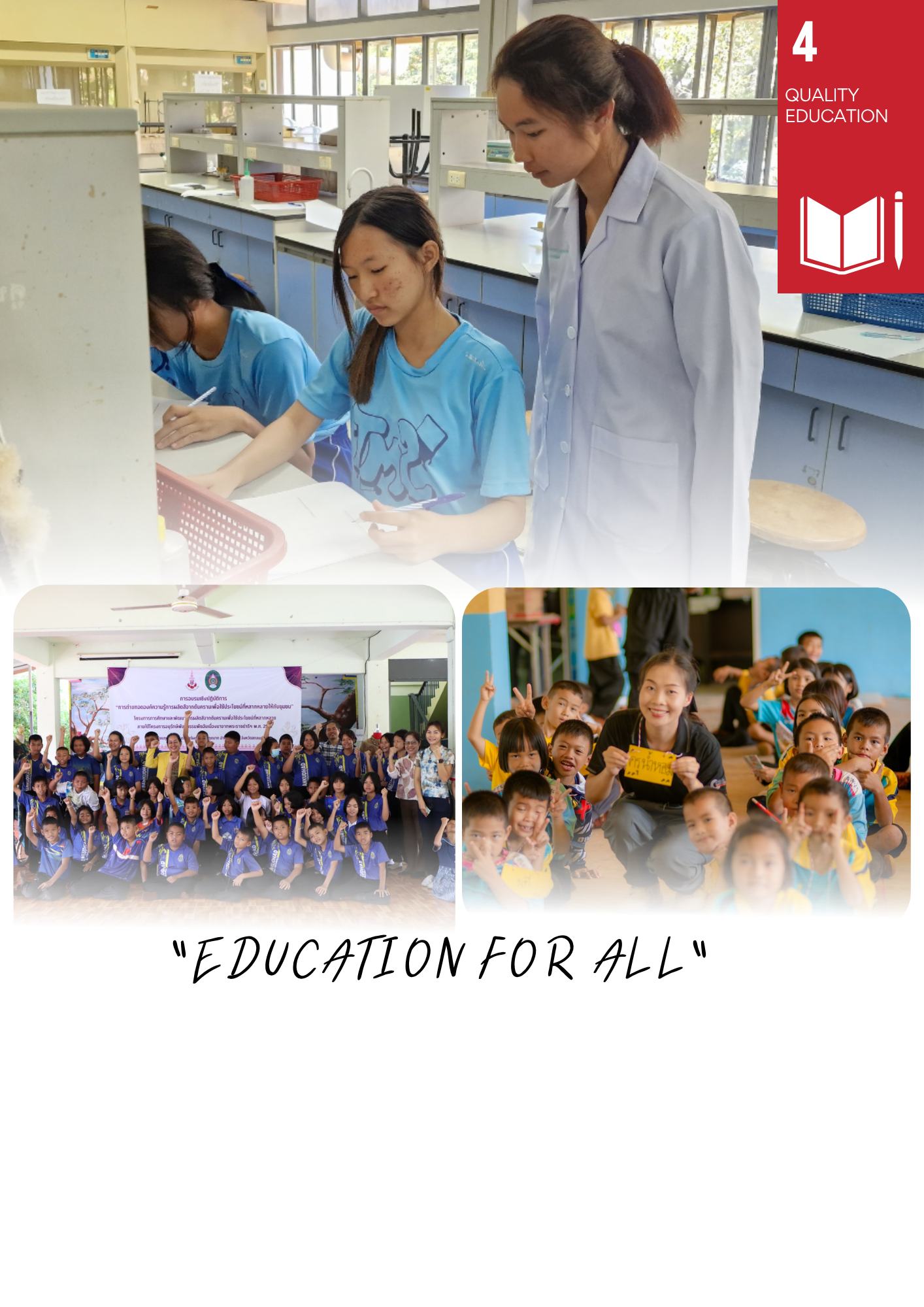
In 2025, SNRU’s Faculty of Education took its “One Program, One Community” policy into small rural schools in Sakon Nakhon and Mukdahan, where pupils have fewer educational opportunities. At Ban Na Ang Muang Kham School, Tao Ngoi District, four programs worked throughout the year: Special Education ran research and teaching-innovation training for teachers of pupils with special needs (6–7 February); Social Studies held a camp for 100 pupils using community learning sites (4 and 14 March); and English Teaching refreshed a classroom, produced teaching materials, and trained 60 pupils as young tour guides (16–17 July). Home Economics ran vocational skills training for 105 teachers and pupils at Dan Muang Kham Phitthayakhom School (20–21 February), and Industrial Education taught basic electrical skills to 80 teachers, pupils, parents, and villagers at Ban Piat School, Dong Luang District, Mukdahan (20–21 February).
Full report: SNRU SDGs Report 2025, SDG 4 Quality Education (pages 38–46).
https://sdgs.snru.ac.th/wp-content/uploads/2026/11/SDG-4-1.pdf
Post Views: 44