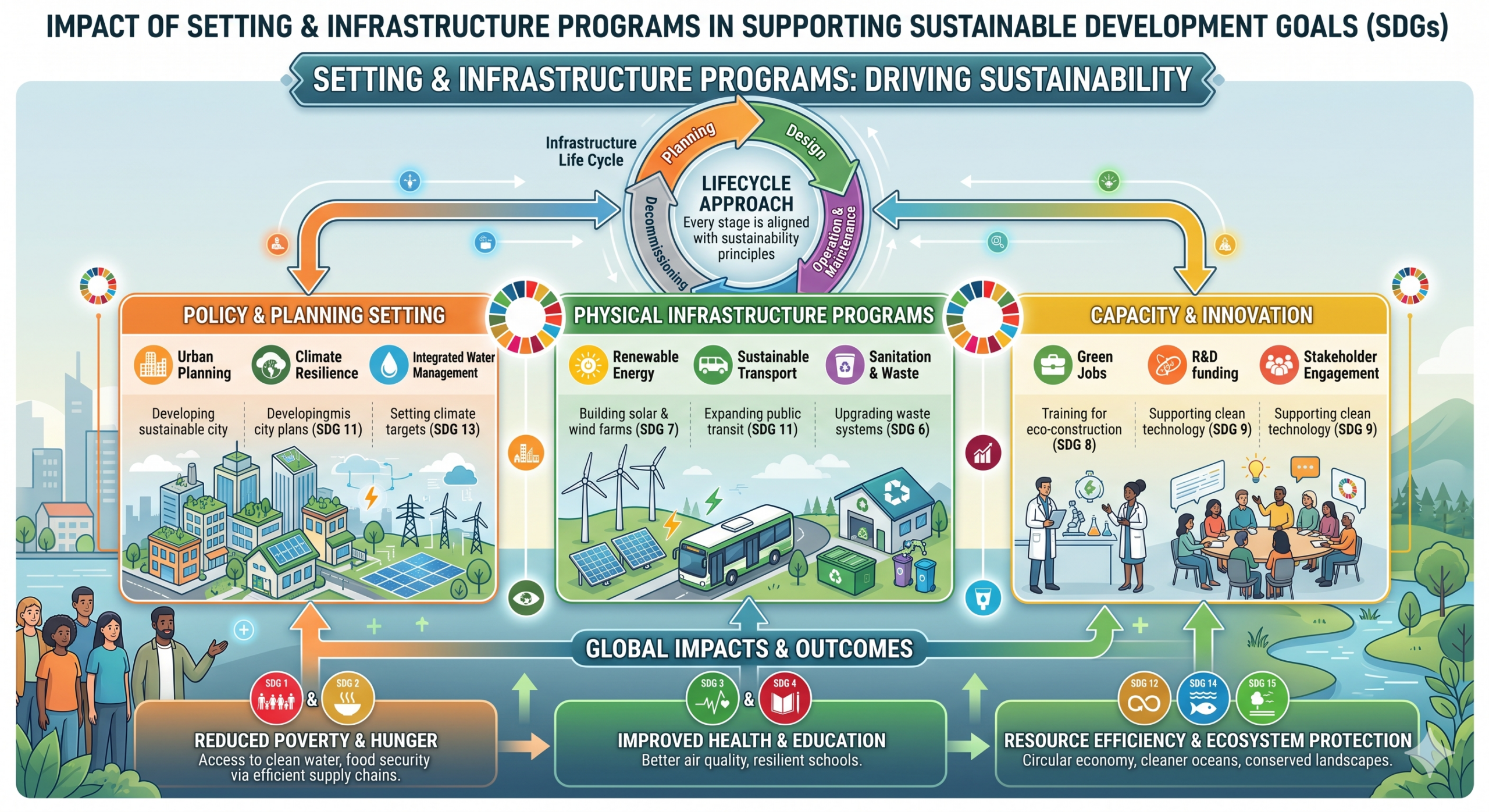
The Impact of Setting & Infrastructure Programs on Supporting the Sustainable Development Goals (SDGs)
Sakon Nakhon Rajabhat University (SNRU)
Sakon Nakhon Rajabhat University (SNRU) strategically leverages its physical master plan, spatial resources, and safety infrastructure to drive progress toward the United Nations Sustainable Development Goals (SDGs). By transitioning the campus into a functional “Living Laboratory,” SNRU demonstrates that the management of the physical environment directly influences ecological sustainability, human well-being, and community resilience.
The comprehensive impacts of SNRU’s setting and infrastructure programs across multiple SDGs are analyzed below:
1. SDG 3: Good Health and Well-being
- High Open Space per Capita for Mental & Physical Health: By maintaining a substantial total open space of 272,683.10 m2, which yields an impressive 26.54 m2 of open space per person for the campus population of 10,276, SNRU directly promotes active lifestyles. This ample unbuilt space ensures that students and staff have excellent access to fresh air, pedestrian walkways, and expansive sports complexes like the Ratchaphruek Stadium, significantly reducing urban stress and improving public health.
- Emergency Life Support Integration: To protect the physical well-being of on-campus residents and visitors, the university has deployed 20 standardized first-aid kits across all buildings and permanently installed an Automated External Defibrillator (AED) at the central administrative hub (Building 10) under the strict supervision of the Nursing Section, safeguarding lives during critical medical emergencies.
2. SDG 4: Quality Education
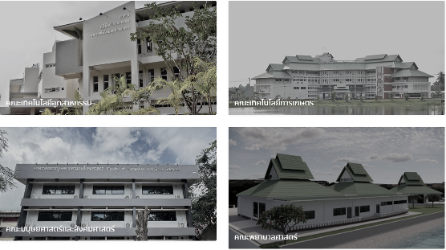
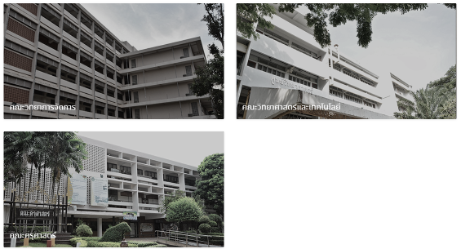
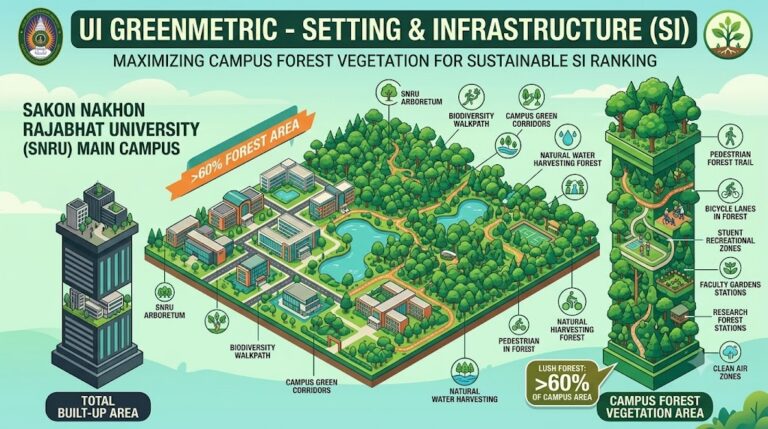
- The Campus as a Living Laboratory: SNRU’s 11,525.00 m2 of natural forest cover and 162,893.00 m2 of systematically planted vegetation serve as open-air classrooms. These spaces provide real-world research sites for the Faculty of Science and Technology and the Faculty of Agricultural Technology (located across Buildings 6, 7, 9, and 12) to study botany, biodiversity, and urban ecosystem conservation.
- Lifelong Safety Education & Action: As documented in the university’s project performance report, safety is embedded into institutional learning. By hosting specialized programs like the “Basic Fire Evacuation and Suppression Training,” the university successfully equips over 100 on-campus residents annually with critical life skills, achieving an evaluation and practical success score of over 80%.
3. SDG 6: Clean Water and Sanitation
- Natural Groundwater Recharge: The large allocation of communal open space (272,683.10 m2), predominantly consisting of unpaved lawns, agricultural fields, and landscape gardens, plays a crucial role in stormwater management. These permeable surfaces maximize natural groundwater absorption, drastically reduce the risk of flash flooding within campus boundaries, and naturally filter surface runoff before it discharges into local water bodies.
4. SDG 7: Affordable and Clean Energy
- Energy Consumption Reduction via Passive Cooling: The extensive coverage of cultivated greenery and tree lines (162,893.00 m2 or 15.99% of the total campus area) acts as a natural shield against the urban heat island effect. Strategically shading academic clusters—such as the General Lecture Building (Building 19) and the Office of the President (Building 10)—regulates the microclimate, minimizes heat accumulation in buildings, and significantly decreases energy consumption from mechanical air-conditioning systems.
5. SDG 8: Decent Work and Economic Growth
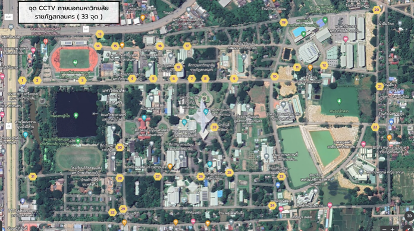
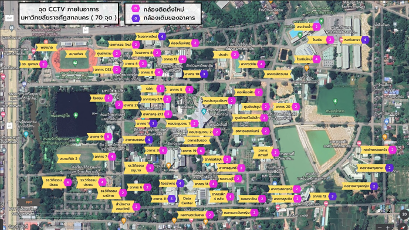
- A Safe, Secure, and Protected Work Environment: Protecting the university’s workforce is a fundamental priority. Through a robust physical infrastructure comprising 102 functional CCTV cameras, a centralized Security Control Center, and 2,200 outdoor lighting points spanning all campus roads and walkways, SNRU ensures a highly secure, accident-free environment. This comprehensive security grid allows faculty, administrative staff, and support workers to perform their duties safely and productively.
6. SDG 8: Decent Work and Economic Growth
- A Safe, Secure, and Protected Work Environment: Protecting the university’s workforce is a fundamental priority. Through a robust physical infrastructure comprising 102 functional CCTV cameras, a centralized Security Control Center, and 2,200 outdoor lighting points spanning all campus roads and walkways, SNRU ensures a highly secure, accident-free environment. This comprehensive security grid allows faculty, administrative staff, and support workers to perform their duties safely and productively.
7. SDG 9: Industry, Innovation, and Infrastructure
- Smart Campus Technology Integration: The implementation of automated License Plate Recognition (LPR) CCTV systems at 4 major campus gates (Gates 1, 2, 3, and 5) reflects a strong commitment to adopting smart infrastructure technologies. By upgrading routine security checkpoints into data-driven digital infrastructure, the university enhances operational efficiency and safety management, serving as a blueprint for smart micro-cities.
8. SDG 10: Reduced Inequalities
- Inclusive and Accessible Public Spaces: SNRU’s 272,683.10 $m^2$ of open space is designed to be highly inclusive. Large public facilities, such as the Ratchaphruek Stadium, are barrier-free and fully accessible to all community members regardless of socioeconomic status, fostering equality by providing equal access to leisure, sports, and assembly spaces for both internal residents and the surrounding local public.
9. SDG 11: Sustainable Cities and Communities
- Disaster Resilience & Hazard Mitigation: Resilient infrastructure is maintained through proactive structural auditing. The campus is equipped with 100 dry-chemical fire extinguishers, 40 high-capacity fire-hose cabinets across large high-rise structures (Buildings 10, 11, 13, 19, 20), automated fire-sprinkler systems (Building 20), and widespread fire-alarm networks. Regular emergency simulations ensure that the community is structurally and behaviorally prepared to handle disasters.
- Safe and Inclusive Transportation Infrastructure: The university manages internal traffic risks by installing 87 official traffic signs and 13 strategically placed speed bumps in high-risk zones, complemented by a License Plate Recognition (LPR) CCTV system at 4 major campus gates (Gates 1, 2, 3, and 5) to secure vehicular flow and protect pedestrian mobility.
10. SDG 12: Responsible Consumption and Production
- Sustainable Asset Management: By maintaining an organized, detailed safety infrastructure registry (e.g., auditing 100 fire extinguishers, 40 fire hose cabinets, and 200 emergency lights), the university promotes responsible consumption patterns. Combined with regular training loops that teach staff how to properly operate and handle equipment, this structured approach extends the life cycle of state assets, minimizes waste, and eliminates unnecessary resource loss.
11. SDG 13: Climate Action
- Carbon Sequestration Ecosystems: The intentional preservation of 11,525.00 m2 of natural forest vegetation cover (1.13% of the total campus area of 1,018,416.00 m2) serves as a core carbon sink. This natural, dense canopy cover actively captures greenhouse gases, offsets carbon locally, and serves as a cornerstone of the university’s climate change mitigation policies.
12. SDG 15: Life on Land
- Terrestrial Biodiversity Conservation: SNRU’s physical setting serves as an ecological buffer that protects local terrestrial habitats. By strictly delineating and protecting natural forest cover from built-up structures (144,507.00 m2 total building footprint), the university safely preserves native flora and fauna species, maintaining ecological harmony within an expanding institutional urban area.
13. SDG 17: Partnerships for the Goals
- Multi-Sectoral Collaboration for Public Safety: SNRU’s infrastructure management extends beyond campus borders to foster strong community networks. As shown in the safety training reports, the university actively collaborates with external government entities, such as the Regional Disaster Prevention and Mitigation Center (Zone 7 Sakon Nakhon) and the Sakon Nakhon City Municipality, to co-host simulation drills and build robust emergency response networks.
Strategic Conclusion
At Sakon Nakhon Rajabhat University, Setting and Infrastructure programs are much more than routine physical maintenance; they are a multi-dimensional foundation for global sustainability. By addressing 13 out of the 17 SDGs, SNRU effectively connects Environmental Stewardship (SDGs 6, 12, 13, 15), Social Safety & Equity (SDGs 3, 4, 5, 10, 11), and Technological & institutional Partnerships (SDGs 7, 8, 9, 17). This quantifiable data proves that SNRU acts as an exemplary model for sustainable campus development in the region.
Post Views: 106