Sakon Nakhon Rajabhat University (SNRU) is a university for local development under the Rajabhat University Act B.E. 2547 (2004). Through its Local Development Strategy, it helps make Sakon Nakhon and the surrounding area liveable, safe, resilient, and sustainable. In FY2025, SNRU ran 38 main projects under this strategy, broken down into 208 sub-projects in 64 communities and villages. SNRU prioritizes protecting and building on the city’s cultural and natural heritage and works with the province, local governments, communities, and the private sector so that Sakon Nakhon grows in balance and keeps its identity. This page summarizes SNRU’s work on SDG 11 in 2025.
11.2.1 Public access to buildings
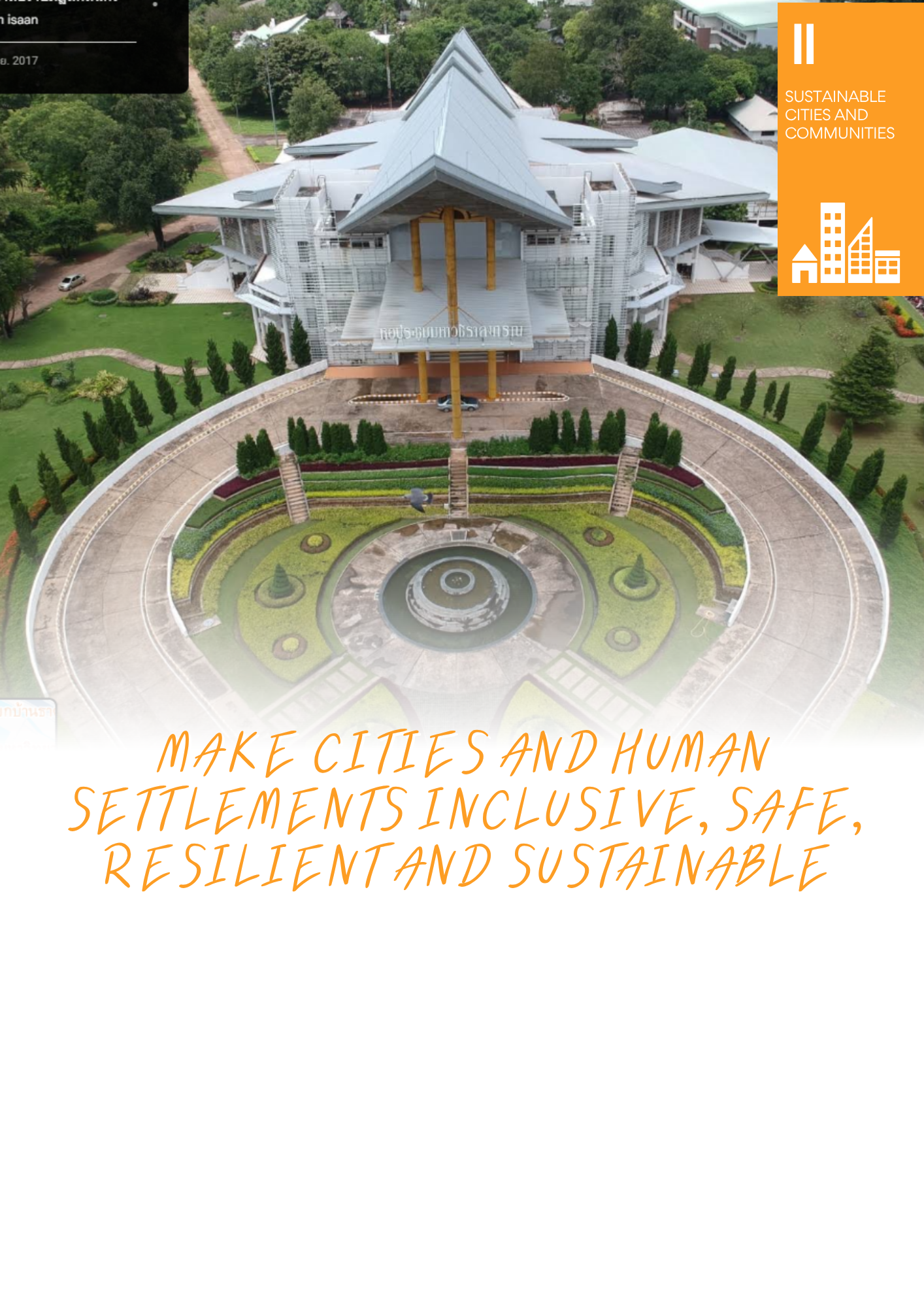
SNRU makes its buildings and venues available to government agencies, private organizations, schools, community groups, and members of the public, including auditoriums, meeting rooms, classrooms, sports grounds, the sports center, multipurpose buildings, and outdoor event spaces. Building 1, a two-story applied Thai-style building constructed in 1963 that has historical and architectural value in its own right, houses the Sakon Nakhon City Museum and is open to the public. Sports grounds and outdoor exercise areas are open to the public free of charge every day; other venues can be booked under the university’s published service rates.
11.2.2 Public access to libraries
The library in the Bannarajanagarindra Building, run by the Office of Academic Resources and Information Technology, is open to students, staff, and the general public free of charge, Monday to Saturday, 08.30–16.30. Members of the public can walk in and use the online catalog (Web OPAC) immediately without registering, and can book seminar and meeting rooms at reserve.snru.ac.th after creating a free account. The library has an air-conditioned co-working space with computers, Wi-Fi, and wired LAN, and digital resources including e-books, the E-Thesis database, and the E-Journal SNRU platform.
11.2.3 Public access to museums
The Sakon Nakhon City Museum, run by SNRU’s Institute of Language, Arts, and Culture, displays important artifacts from Sakon Nakhon Province, including the revered Luang Pho Phra Saen Mueang Sakon Buddha image, a Shiva linga, boundary stones (sema), Ban Chiang pottery and bronzes, and cabinets of scriptures. Its sections trace the region’s story from prehistory through the Dvaravati, Lopburi, and Lan Xang periods to the cultures of six ethnic groups in Sakon Nakhon. The museum is open to the public Tuesday to Friday, 09.00–16.00; admission is 10 baht for Thai visitors and 20 baht for foreign visitors. It also offers guided lectures for students, monks, novices, tourists, and the public; special exhibitions for festivals; and a bilingual museum guidebook.
11.2.4 Public access to green spaces
SNRU’s outdoor green and open spaces are open to the public free of charge every day. They include the Ratchaphruek Stadium with its athletics track, the Nong Ya Sai Sports Field, and the shaded jogging path around Nong Ya Sai Pond in the Nong Ya Sai Health Park, with outdoor exercise equipment. The campus reservoirs of Nong Bak Dao, Nong Hai, and Nong Ya Sai, planted with drought-tolerant native trees, form a green landscape that residents use for running, walking, and exercise.
11.2.5 Arts and heritage contribution
SNRU helps keep Sakon Nakhon’s major traditions alive through public performances and events. With Sakon Nakhon Province and Sakon Nakhon City Municipality, it co-hosted the 2025 Wax Castle Festival on 2–6 October 2025 at the King Rama V Monument plaza, with local cultural performances, a light-and-sound stage, and a parade of five contemporary wax castles telling cultural stories. Under its Community Soft Power Enhancement project, SNRU staged 2 living exhibitions and the “Sakon Nakhon Textiles” fashion show.
11.2.6 Record and preserve cultural heritage
In FY2025, SNRU’s Institute of Language, Arts and Culture produced 28 bodies of knowledge on Thai arts and culture and developed 5 prototypes for arts and culture preservation under its Arts and Culture Preservation for Community Value project. Its Community Soft Power Enhancement project supported 2 communities, including Ban Na Khi Nak, Phu Phan District, and produced 3 bilingual community identity media, and trained villagers in hand-spun, naturally dyed cotton production. SNRU’s Thai Language Teaching program helped pupils at Ban Na Ang Muang Kham School revive Isan sarapanya chanting and traditional khan mak beng crafts, and the “Ja-Learn-Mueang” project built a knowledge base on the history and culture of Sakon Nakhon’s old town.
11.3.1 Arts and heritage expenditure
In FY2025, SNRU allocated 3,980,000 baht to arts and heritage under its strategy to integrate and enhance work on language, religion, arts, culture, and local wisdom: 980,000 baht for the Arts and Culture Preservation for Community Value project and 3,000,000 baht for the Community Soft Power Enhancement Based on Local Cultural Identity project.
11.4.2 Promote sustainable commuting
SNRU recognizes travel as a significant source of its greenhouse gas emissions and works to reduce private car use on campus. It runs a free university tram service (SNRU E-BUS, 22-seat electric trams) on a loop linking the Integrated Learning Building, the swimming pool, the Central Library, and the student dormitories, Monday to Friday. The university also provides electric golf carts, an electric tricycle, and electric bicycles for short trips around campus, free of charge, and its Energy Reduction Guidelines ask staff to plan official vehicle use, share rides, and hold meetings online to save fuel.
11.4.4 Affordable housing for employees
Under the SNRU Regulation on Criteria and Procedures for Allocating University Housing to Staff, B.E. 2567 (2024), the university offered 378 staff housing units in FY2025, including 98 staff houses, the 24-unit Ratchaphruek Family Apartments, the Chamchuri Men’s and Fueang Fa Women’s Residences, and the Kan Kraw Staff Residence. Rent is below market rates: 500 baht a month for a staff house, 1,300 baht for a single room, and 2,600 baht for a family room. With the Government Savings Bank, SNRU also runs the “SNRU Staff Welfare Housing Loan Program,” which offers staff special loan terms to buy, build, or renovate a home.
11.4.5 Affordable housing for students
SNRU runs three on-campus student dormitories, Kan Kraw, Ratchaphruek, and Erawan, under the Regulation on Student Dormitory Management, B.E. 2553 (2010). Fees are charged per term, from 3,000 baht per person per term (about 600 baht a month) for shared rooms to 13,500 baht for an air-conditioned single room. Students from low-income families can therefore live in good-quality housing on campus, save on travel, and have more time for study.
11.4.6 Pedestrian priority on campus
SNRU has connected pedestrian pathways across campus, with 3,243.5 m (9,046.35 m²) of covered walkways, accessible routes, and building entrance ramps for persons with disabilities, so students, staff, and visitors can walk safely between buildings.
11.4.7 Local authority collaboration regarding planning and development
SNRU works with Sakon Nakhon Province and Sakon Nakhon City Municipality on the city’s planning and development, under a memorandum of understanding with the municipality signed on 2 June 2023. In 2025, the Civil Engineering and Architecture program and the Research and Development Institute led the “Sakon Junction: Ja-Learn-Mueang” project with the province and partners, launched at the municipality on 14 May 2025, to develop knowledge, learning activities, and designs for public learning spaces in the old town around Wat Phra That Choeng Chum. On 26 February 2025, SNRU co-hosted the “Area Need 3” consultation, presenting a provincial SDG Index for the Northeast. After floods in June 2025, SNRU’s “Sakon Nakhon SMART Water” project with the municipality mapped flood risk for 79 households and installed two real-time water-level stations.
11.4.8 Planning development—new build standards
SNRU requires every new building and renovation project to meet energy-efficiency and sustainability standards under its “Policy on Energy Efficiency Standards in Renovations and New Constructions (2023–2026)” and its “Policy for Energy Conservation and Environment” (25 July 2024). New buildings follow the Building Energy Code, using natural light and ventilation, insulation, and building orientation to reduce heat gain, with roof structures ready for solar PV. All 25 core buildings use LED lighting; 46% are designed for natural ventilation; rooftop solar PV is installed on seven buildings (505.28 kWp); and smart building systems cover 18,687.54 m² (19.63% of total building area).
Full report: SNRU SDGs Report 2025, SDG 11 Sustainable Cities and Communities (pages 78–84).
https://sdgs.snru.ac.th/wp-content/uploads/2026/11/SDG-11-1.pdf
Post Views: 86