Sakon Nakhon Rajabhat University (SNRU) lies in the Sakon Nakhon Basin, beside Nong Han, one of the largest natural freshwater lakes in Northeast Thailand, and close to key tributaries such as the Nam Un River. Local communities have relied on these waters for food, income and culture for generations, so SNRU treats the conservation of freshwater ecosystems as a core mission. The Nong Han Center of Excellence leads its research and innovation for the restoration of Nong Han, and the Aquaculture Science program of the Faculty of Agricultural Technology works directly with riverside communities. This page summarizes SNRU’s work in 2025.
14.2.1 Fresh-water ecosystems (community outreach)
In 2025, the Fisheries program of SNRU’s Faculty of Agricultural Technology ran a project to raise awareness of conservation and restore the Nam Un River ecosystem at Ban Phok Yai, Phok Noi Subdistrict, Phanna Nikhom District, Sakon Nakhon, with a budget of 250,000 baht. The team developed a community training curriculum on aquatic animal production and conservation, taught in the local dialect, so that villagers understand how fragile their freshwater resources are and how to protect them.
On 9 August 2025, the Environmental Science program and the Nong Han Center of Excellence opened the Nong Han Learning Center at the Ban Tha Wat pavilion, Wat Maha Phrom Phothirat, Lao Po Daeng Subdistrict, Mueang Sakon Nakhon District. Located on the shore of Nong Han, the center gives residents and visitors a place to learn about the lake’s ecosystem, natural resources and biodiversity.
14.2.2 Sustainable fisheries (community outreach)
Through the Nam Un River curriculum at Ban Phok Yai, SNRU helped villagers learn their legal rights and duties and agree on fair rules for using fish conservation zones and protected areas. The Aquaculture Science program also shares sustainable fisheries knowledge with young people in the region. It visited Phon Sawan Ratsadon Phatthana School, Nakhon Phanom, on 30 July 2025, and Ban Phon Phaeng Chiarawanon Uthit 5 School, Kusuman District, Sakon Nakhon, on 4 December 2025, teaching students about aquatic animal breeding, aquaculture feed and careers in sustainable fisheries.
14.2.3 Overfishing (community outreach)
A 2024 community needs survey at Ban Tham Si Kaeo, Sang Kho Subdistrict, Phu Phan District, found that wild-caught climbing perch could no longer meet local demand. On 24–25 June 2025, the Aquaculture Science program ran a hands-on workshop on climbing perch farming covering broodstock selection, water quality management, efficient feeding and disease prevention. Farming the fish reduces pressure on wild stocks, creates income and food security, and lays the groundwork for a future subdistrict aquaculture learning center.
14.3.1 Conservation and sustainable utilisation of the oceans (events)
On 8 February 2025, the Nong Han Center of Excellence held World Wetlands Day 2025 at Don Doen Public Park, Tha Rae Subdistrict, Sakon Nakhon, under the theme “Protecting Wetlands for Our Common Future”. More than 300 local residents attended. The event included a panel discussion, “Wetland Policy: From International Frameworks to Nong Han”, “TED Talk Nong Han” short talks on wetland protection and conservation-focused tourism, and posters of Nong Han’s bird species to raise awareness of the lake’s biodiversity.
14.3.2 Food from aquatic ecosystems (policies)
SNRU’s Policy on Food Quality, Sustainability and Access on Campus, announced on 1 November 2024, applies to all canteens, food outlets, catering services and vending machines on campus. It treats seafood as a high-risk product: it must come from suppliers with recognized sustainability or ethical certification, so the university does not buy from overfished, illegal or destructive fisheries. Food is sourced first from local farmers and producers in the Sakon Nakhon region, including freshwater fish from local fish farmers. A Campus Food Policy Committee monitors compliance, and the policy is reviewed every three years.
14.3.3 Maintain ecosystems and their biodiversity (direct work)
At Ban Phok Yai, SNRU bred local fish such as silver barb on site and released the fry back into the Nam Un River to restore fish populations and freshwater biodiversity. On 8 December 2025, SNRU worked with the Sakon Nakhon Inland Fisheries Research and Development Center and the Disaster Prevention and Mitigation Center Region 7 to sort aquatic animals from Nong Ya Sai pond on campus. Species suitable for the wild were released into Nong Han, Huai Tiak Reservoir, and a pond at Wat Pa Khun Kham Wipatsana, Kut Bak District.
14.3.4 Technologies towards aquatic ecosystem damage prevention (direct work)
SNRU developed a mobile aquatic hatchery kit that lets communities breed local fish on site with lower fry mortality, reducing reliance on wild catch. On campus, the university’s aquaculture farm runs three biofloc ponds, which minimize water exchange and wastewater discharge, and an aquaponics system that recycles fish waste as plant nutrients.
14.4.1 Water discharge guidelines and standards
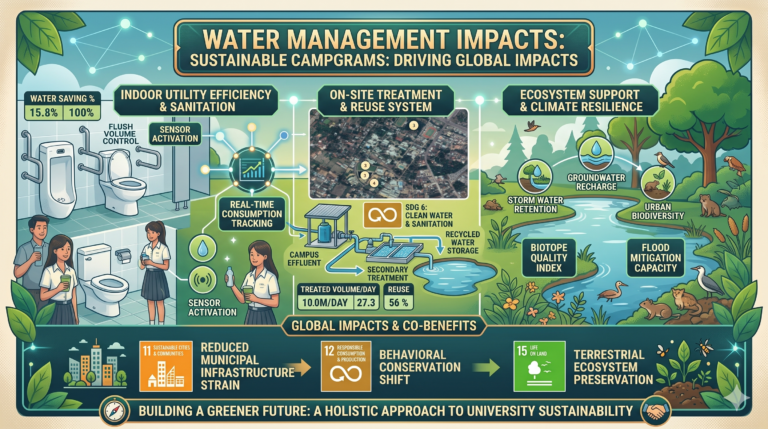
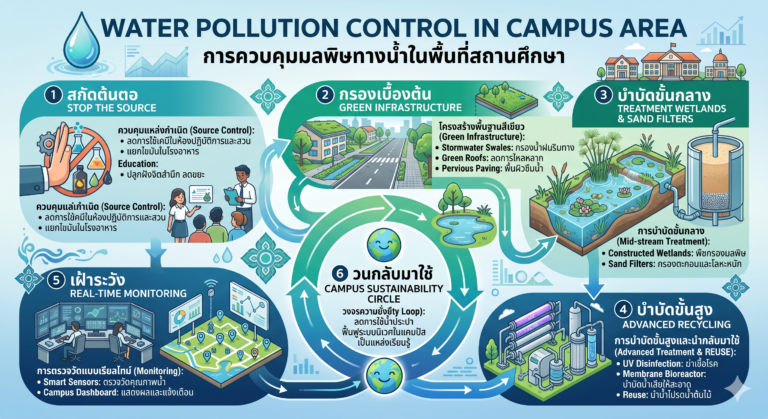
All building wastewater on campus passes through a biological aeration treatment system with 62 aeration units, which treated 99,411.84 m³ of wastewater in 2025. Equipment is inspected monthly, and system operation and effluent quality are reported to the Pollution Control Department every month. Treated water then flows through a constructed wetland and holding ponds, and 10,944 m³ a year is reused to irrigate campus green spaces instead of being discharged.
14.4.2 Action plan to reducing plastic waste
SNRU’s plastic reduction policy and its Green Office 3R program aim to keep plastic waste out of waterways. On 6 August 2025, the Agricultural Technology and Innovation Center ran a project to reduce and reuse plastic waste with 247 staff, university students and pupils from the Withitham Demonstration School. Participants learned to sort waste, joined a campaign to replace single-use plastic bags, cups and straws with cloth bags and personal water bottles, and turned plastic waste into useful items. Waste sorting points were set up, and an environmental volunteer network was formed among schools.
14.5.2 Monitoring the health of aquatic ecosystems
On 24 November 2025, SNRU’s Research and Development Institute, the University of Education – The University of Danang (Vietnam), government agencies, civil society and the Sakon Nakhon Bird Conservation Club carried out a field bird survey in the Nong Han wetland. The team recorded a flock of more than 300 Glossy Ibis at Don Hin, a sight rarely seen in Thailand that signals the health of the wetland ecosystem. In FY2025, SNRU also built a Nong Han resource database that supports the planning of restoration and conservation of the lake’s ecosystem.
14.5.3 Programmes towards good aquatic stewardship practices
Under its project to develop a center of excellence for sustainable community resource management, SNRU produced a Nong Han learning center, a resource database and learning materials in FY2025. These help communities plan grassroots economic development such as ecotourism, raise public awareness of conserving Nong Han, and promote community products under the “Wetland BCG” brand, which applies the Bio-Circular-Green economy model to local livelihoods.
14.5.4 Collaboration for shared aquatic ecosystems
Nong Han is shared by many communities and agencies. At World Wetlands Day 2025, SNRU brought together an adviser to the Minister of Natural Resources and Environment, the Governor of Sakon Nakhon, the Director of the Regional Water Resources Office 3 (Udon Thani), a water management expert from the Stockholm Environment Institute (SEI), the Association for Sustainable Watershed Development, and local communities. Together they set out the shared goal of having Nong Han designated a Wetland of International Importance under the Ramsar Convention. The Nong Han Center of Excellence also works with WWF Thailand on forums to conserve the Nong Han wetland.
Full report: SNRU SDGs Report 2025, SDG 14 Life Below Water (pages 92–96).
https://sdgs.snru.ac.th/wp-content/uploads/2026/11/SDG-14-1.pdf
Post Views: 91