Sakon Nakhon Rajabhat University (SNRU) lies between the Phu Phan mountain range and the Nong Han wetland, an area rich in dry dipterocarp forest, dry evergreen forest, and native plants. The university treats the conservation of land ecosystems as a mission that ties together research, teaching, and community service. Two university policies guide this work: one on sustainable land use, conservation, and restoration, including monitoring IUCN-listed species, and one to reduce the impact of invasive species. Together, they require SNRU to plan land use that supports biodiversity, restore degraded areas with native trees, monitor threatened species, and prevent the spread of invasive species, with annual progress reports and a policy review every three years. This page summarizes SNRU’s work on SDG 15 in 2025.
15.2.1 Events about sustainable use of land
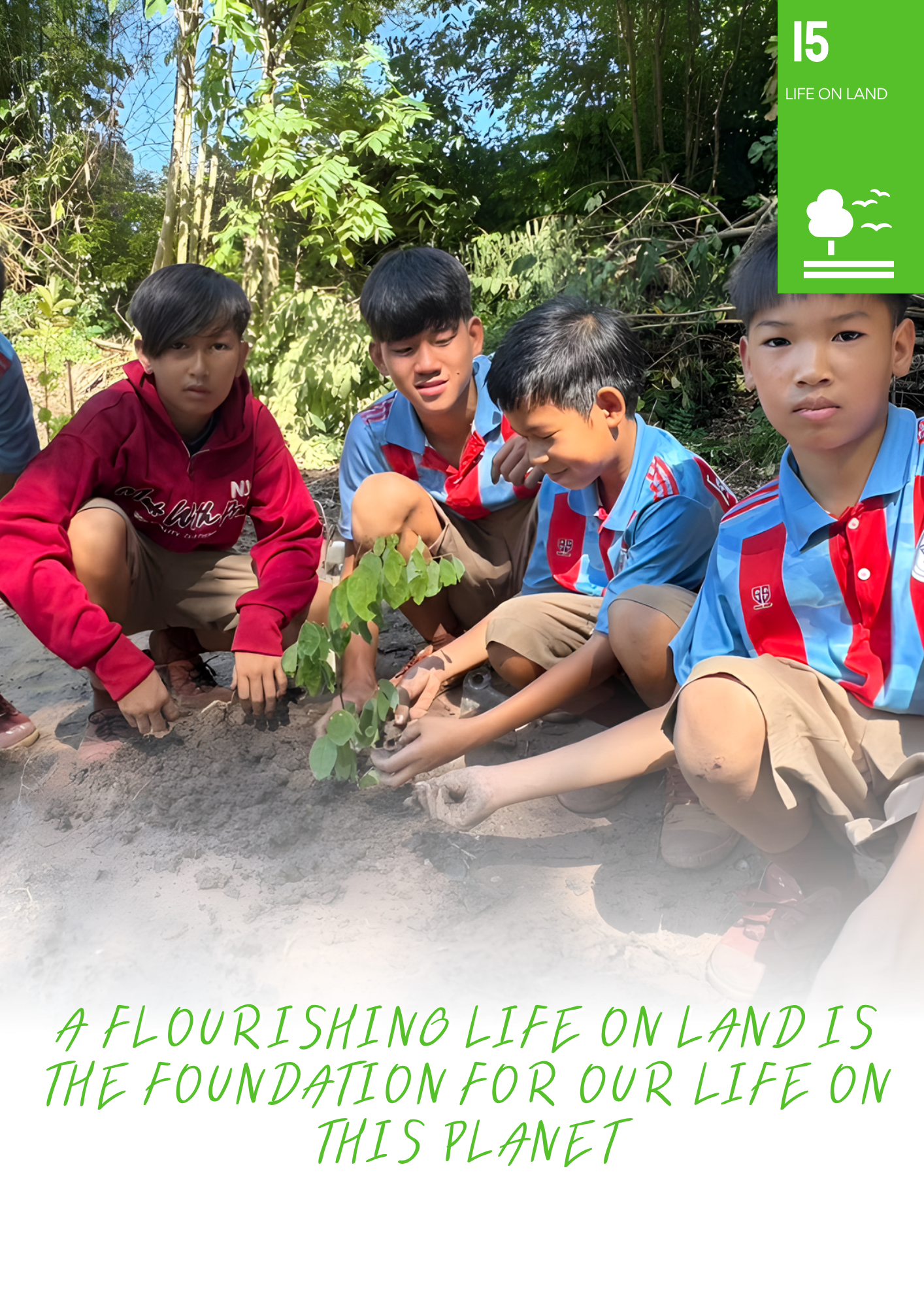
On 21–22 July 2025, SNRU’s Animal Science program held the third year of its “Forest Planting for Watershed Protection and Biodiversity Conservation” event at Khok Phu Subdistrict Municipality, Phu Phan District. More than 210 people took part, including 98 school students, 62 officials from the municipality, the Royal Forest Department, the Department of National Parks, Wildlife and Plant Conservation, and local leaders; 40 university students; and members of the public. The event combined a lecture on the importance of forests, water sources, and ecosystems with the planting of native trees. On campus, SNRU’s “Planting Trees into a Great Forest” event for World Environment Day planted 1,600 seedlings donated by the Sakon Nakhon Provincial Office of Natural Resources and Environment.
15.2.2 Sustainably farmed food on campus
SNRU’s Policy on Food Quality, Sustainability, and Access on Campus (1 November 2024) applies to all canteens, food outlets, catering services, and vending machines. It requires vegetables and fruit to be local, seasonal, and free of chemical residues, with priority for produce from Sakon Nakhon farmers, safe-vegetable networks supported by the Faculty of Agricultural Technology, and campus gardens; animal products must come from certified, hygienic sources. A Campus Food Policy Committee monitors compliance, and the policy is reviewed every three years. On campus, the Faculty of Agricultural Technology grows safe vegetables in its greenhouses and RD6 glutinous rice in a demonstration paddy, and students in the “SNRU Dorm Kids’ Farm” grow pesticide-free vegetables for the campus community.
15.2.3 Maintain and extend current ecosystems’ biodiversity
SNRU works directly to restore forests in the Phu Phan range. In Years 1 and 2 (FY2023–2024) of its watershed forest project at Khok Phu Subdistrict, more than 7,000 trees were planted. In Year 3 (21–22 July 2025), the team planted native trees such as yang na, padauk, teak, Siamese rosewood, and makha, with more than 3,500 native seedlings donated by the Department of National Parks, Wildlife and Plant Conservation. The planting adds green space and biodiversity, protects the watershed and reduces drought risk. On campus, SNRU conserves economically important local plant, livestock and fish genetic resources on its farm plots, linked to the Plant Genetic Conservation Project under the Royal Initiative of HRH Princess Maha Chakri Sirindhorn (RSPG).
15.2.4 Educational programs on ecosystems
On 25–28 February 2025, SNRU’s RSPG coordination center ran a free, hands-on training on surveying and building local resource databases using nine worksheets for teachers and staff of member schools, botanical gardens, and local government organizations. Participants learned to record local plants, animals, micro-organisms, and local wisdom and carried out fieldwork in Ban Non Nam Kham and Ban Phrom Si That, Khok Si Suphan District. On 21 March 2025, SNRU’s Research and Development Institute published the free e-book “Nong Han Birdwatching Guide,” which documents 90 bird species found in the Nong Han wetland.
15.2.5 Sustainable management of land for agriculture (educational outreach)
SNRU’s Plant Science program shares sustainable farming knowledge with local farmers. On 23 April 2025, it built a network for safe Chinese chive production at Ban Bueng Daeng, Khok Kong Subdistrict, mentored by the Phak Tho Phu Thao group, which inspects plots against safe-agriculture standards and buys produce at a guaranteed 30 baht/kg; farmers’ incomes rose by 728 baht a month (10.12%). On 16–17 and 19 July 2025, the program extended the model to Chiang Sue Subdistrict, where farmers from three communities set up seven demonstration plots for pesticide-free vegetables.
15.2.6 Sustainable management of land for tourism (educational outreach)
The “Nong Han Birdwatching Guide” e-book (21 March 2025), free to read via QR code, includes a map of birdwatching routes, a code of conduct for birdwatching in nature, and relevant wildlife protection law, promoting responsible ecotourism in the Nong Han wetland. On 14 August 2025, SNRU’s Carbon Neutrality Center hosted the panel “Sakon Next: New-Normal Tourism, Low-Carbon Style” for community enterprises, tourism and hotel operators, students and the public and signed an agreement with the Sakon Nakhon Tourism Industry Council to develop sustainable low-carbon tourism.
15.3.1 Sustainable use, conservation, and restoration of land (policy)
SNRU’s policy on sustainable land use, conservation, and restoration requires the university to plan land use that supports biodiversity and to restore degraded areas with native trees, with annual progress reports and a policy review every three years.
15.3.2 Monitoring IUCN and other conservation species (policies)
The same policy requires SNRU to monitor IUCN-listed and other threatened species in areas affected by its operations, with annual progress reports and a review every three years.
15.3.3 Local biodiversity included in planning and development
SNRU’s environmental science researchers have assessed carbon storage in more than 2,000 campus trees of 23 species to guide green-space management. For its green spaces, SNRU plants drought-tolerant native species suited to the local climate, such as golden shower (Cassia fistula), rain tree (Samanea saman), and flame of the forest (Butea monosperma), and keeps its reservoirs Nong Bak Dao, Nong Hai, and Nong Ya Sai as natural water bodies within the campus landscape.
15.3.4 Alien species impact reduction (policies)
SNRU’s policy to reduce the impact of invasive species requires the university to prevent the spread of invasive species on campus, with annual progress reports and a policy review every three years. When aquatic animals were relocated from Nong Ya Sai pond on 8 December 2025, they were sorted with the Sakon Nakhon Inland Fisheries Research and Development Center so that only species suitable for the wild were released into natural water bodies.
15.3.5 Collaboration for shared land ecosystems
SNRU works with local communities and agencies to maintain shared land ecosystems. Its forest planting project in Khok Phu Subdistrict is run with the Khok Phu Subdistrict Municipality, the Royal Forest Department, the Department of National Parks, Wildlife and Plant Conservation, local subdistrict and village heads, schools, and residents; some seedlings were given to residents to plant at home. Through its RSPG coordination center, SNRU trains teachers and local government staff in Sakon Nakhon, Nakhon Phanom, Mukdahan, and Bueng Kan to survey, record, and conserve the biological resources of their own areas.
15.4.1 Water discharge guidelines and standards
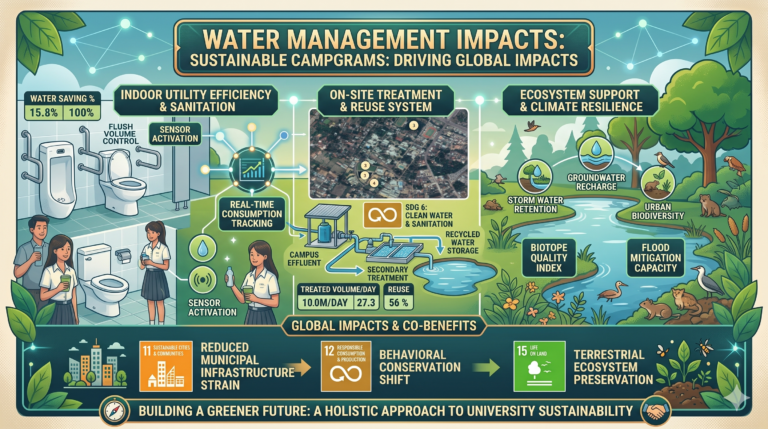
All building wastewater on campus is treated in a biological aeration system with 62 aeration units (99,411.84 m³ in 2025) before discharge. Equipment is inspected monthly, and system operation and effluent quality are reported to the Pollution Control Department every month. Treated water passes through a constructed wetland and holding ponds, and 10,944 m³ a year is reused for campus irrigation.
15.4.2 Policy on plastic waste reduction
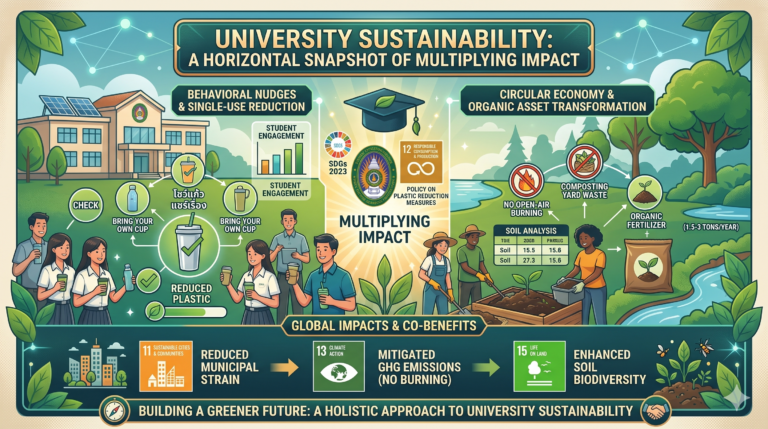
SNRU’s plastic reduction policy, its Green Office Policy, and its 3R (Reduce, Reuse, Recycle) program require offices to cut paper and plastic use, and its food policy asks campus vendors to reduce foam and single-use plastics. On 6 August 2025, a plastic reduction project with 247 staff, students, and pupils set up waste-sorting points and launched a campaign to replace single-use bags, cups, and straws with cloth bags and personal bottles.
15.4.3 Policy on hazardous waste disposal
Under SNRU’s Green Office Policy and Energy and Environmental Conservation Policy, hazardous and chemical waste from laboratories goes to a dedicated storage room, where it is segregated and labeled before authorized agencies collect it for proper disposal. On 13 June 2025, SNRU and Khon Kaen University held a workshop on the ESPReL laboratory safety checklist to bring national best practice in managing hazardous substances into SNRU’s laboratories.
Full report: SNRU SDGs Report 2025, SDG 15 Life on Land (pages 97–102).
https://sdgs.snru.ac.th/wp-content/uploads/2026/11/SDG-15-1.pdf
Post Views: 80