Academic buildings, Office buildings, Roads, and Parking lots
University-wide coverage
Buildings and Vehicles Section
2
Security Control Center
1 center
Office buildings
Entire campus area
Security Section
3
Security Guards
23 personnel
Entrance-Exit gates and Checkpoints
University-wide coverage
Security Section
4
License Plate Recognition (LPR) CCTV System
4 points
Gates 1, 2, 3, 5
Gates 1, 2, 3, 5
Buildings and Grounds Section
5
Dry Chemical Fire Extinguishers
100 units
All buildings
Every building
Buildings and Grounds Section
6
Fire Hose Cabinets
40 units
High-rise and Large buildings
Building 10, Building 20, Building 19, Building 11, Building 13
Buildings and Grounds Section
7
Fire Alarm System
4 buildings
Academic and Office buildings
Building 10, Building 13, Building 19, Building 20
Buildings and Grounds Section
8
Fire Sprinkler System
1 building
Building 20
Installed building area
Buildings and Grounds Section
9
Emergency Lights
200 sets
Hallways and Stairwells
All large buildings
Buildings and Grounds Section
10
Exit Signs
200 signs
All buildings
Every building
Buildings and Grounds Section
11
Automated External Defibrillator (AED)
1 unit
Building 10
Staff, Students, and Visitors
Nursing Section
12
First Aid Kits
20 sets
All buildings
Every building
Nursing Section
13
Outdoor Lighting
2,200 points
Roads, Parking lots, and Walkways
University-wide area
Buildings and Grounds Section
14
Traffic Signs
87 signs
Internal campus roads
All campus roads
Security Section
15
Speed Bumps
13 points
Main roads
High-risk areas
Security Section
16
Emergency button
56 points
Building 9, 10, 11, 14, 17, 19, 20, 22, 23, 24 and Ratchaphruek Stadium
New building
Buildings and Grounds Section
emergency hotline/button
fire extinguisher, hydrant
Security Center in University
Sakon Nakhon Rajabhat University (SNRU) strictly prioritizes the physical safety, property security, and emergency preparedness of all students, faculty, and campus residents. The institution actively maintains a comprehensive, university-wide network of security and safety infrastructure that is fully functional, regularly audited, and managed by dedicated, certified personnel. The functional status of SNRU’s campus-wide security and safety infrastructure is distributed as follows:
Comprehensive Surveillance & Access Control (CCTV & LPR): A total of 102 fully operational CCTV cameras are strategically deployed across all academic and administrative complexes, primary road networks, and campus parking areas to maintain continuous visual surveillance. This is reinforced by a specialized License Plate Recognition (LPR) system at 4 major entry-exit points (Gates 1, 2, 3, and 5) that monitors and secures vehicular access. All visual data streams directly flow into a centralized, 24/7 Security Control Center.
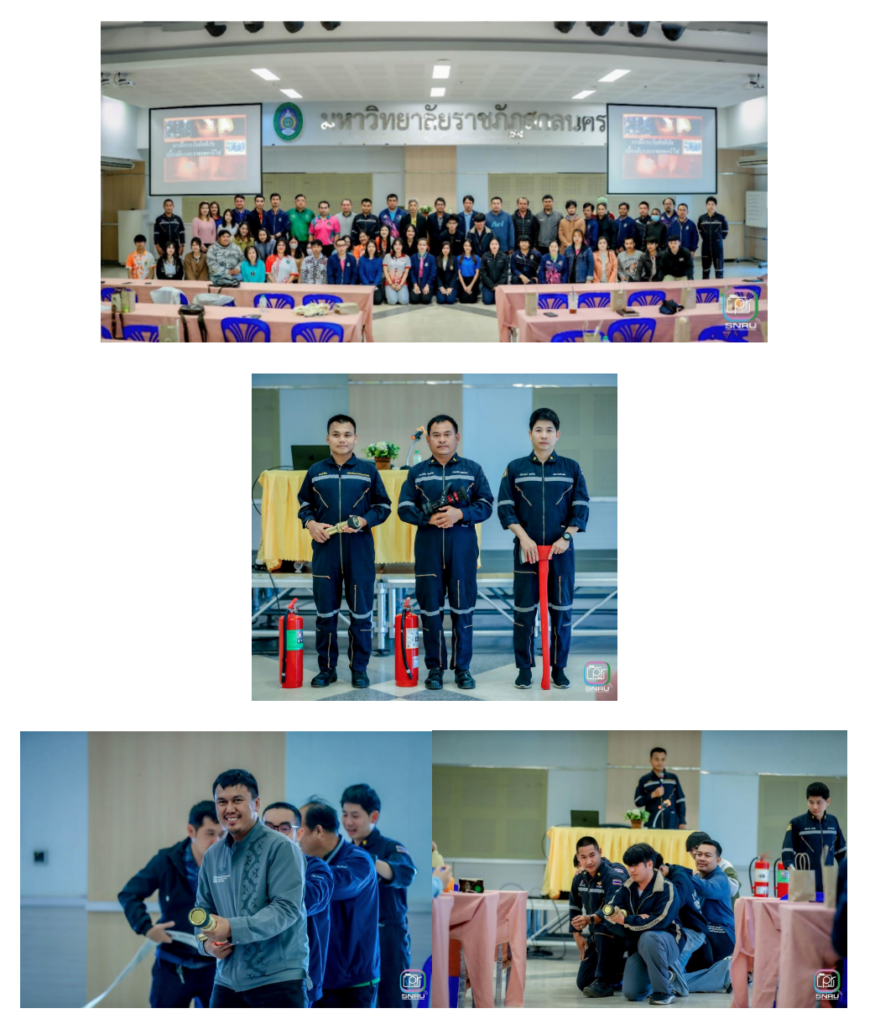
Certified Security & Emergency Personnel: The university maintains a dedicated frontline task force of 23 professionally trained security guards stationed at various perimeter gates and internal checkpoints throughout the university grounds. To ensure regulatory compliance and situational readiness, these personnel regularly undergo professional development. For instance, on Friday, January 31, 2025, the university executed the “Basic Fire Evacuation and Suppression Training” program. This project certified over 100 on-campus participants—including security personnel, building supervisors, staff, and students—in practical skills, with an evaluation success rate over 80%.
Fire Suppression & Prevention Infrastructure: Every structural facility across the campus is equipped with active fire suppression systems. This encompasses 100 dry-chemical fire extinguishers; 40 professional fire hose cabinets strategically installed throughout high-rise and large-capacity complexes (including Buildings 10, 11, 13, 19, and 20); and structural fire alarm systems active across key high-density administration and lecture zones. Furthermore, a heavy-duty automated fire sprinkler system protects the central Multi-Purpose Complex (Building 20).
First Aid & Emergency Life Support: For medical emergencies and immediate first aid, 20 standardized first-aid kits are distributed in every active building on campus. Crucially, an automated external defibrillator (AED) is permanently installed at the Office of the President (Building 10) for public use, managed directly under the oversight of the university’s nursing section.
Campus Illumination & Traffic Safety: To safeguard pedestrian and vehicular movement during evening hours, a robust outdoor lighting grid comprising 2,200 active illumination points lines the university’s main roads, walkways, and parking lots. Traffic flow and speed control are strictly managed via 87 official traffic signs and 13 strategically placed speed bumps in high-risk zones.
Sakon Nakhon Rajabhat University (SNRU) demonstrates a structured, significant impact on the United Nations Sustainable Development Goals (SDGs) through its diverse portfolio of education, research, and community outreach programs. As documented in the university’s institutional reporting and performance showcases, the curriculum and academic initiatives directly support at least 6 to 7 distinct SDGs: This comprehensive […]
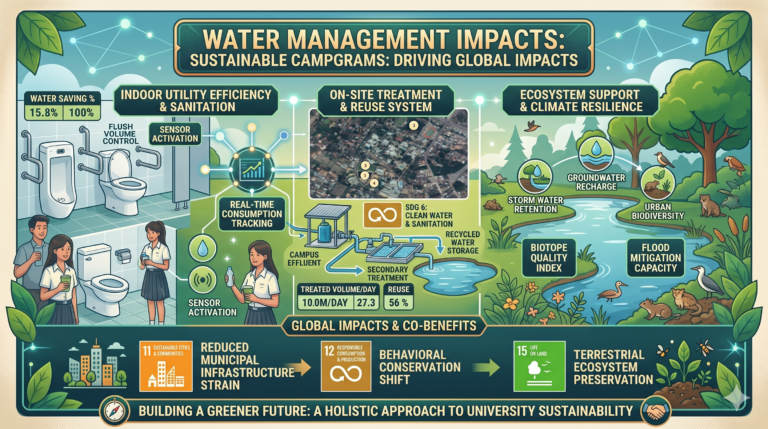
Integrated Impact of Water Management Programs on the SDGs The university’s water management initiatives are driven by a holistic framework. While centered around clean water infrastructure, the program generates cross-cutting impacts that simultaneously support four distinct Sustainable Development Goals (SDGs): [ SDG 6: Clean Water ] │ ┌────────────────────────┼────────────────────────┐ ▼ ▼ ▼ […]
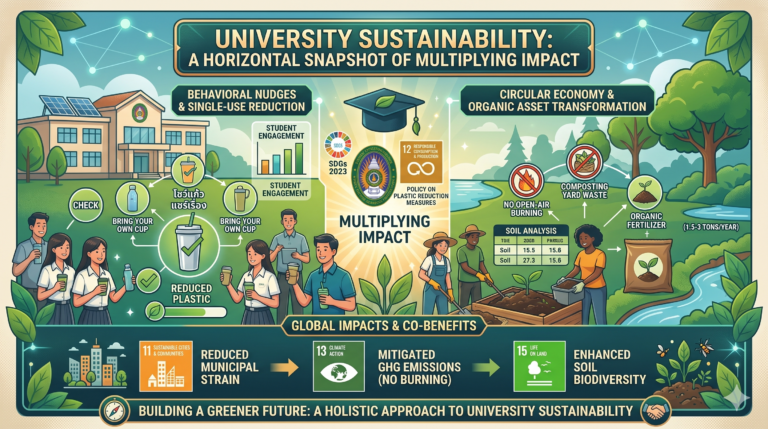
Integrated Impact of Waste Management Programs on the Sustainable Development Goals (SDGs) While the university’s baseline framework originates from SDG 12: Responsible Consumption and Production, the operational practices executed by the Buildings and Vehicles Ground Division demonstrate a powerful, systemic impact that cuts across multiple global goals. ♻️ SDG 12: Responsible Consumption and Production (Core […]