Target 1. Establish an environmentally friendly wastewater, garbage, and hazardous waste management system by 2018. 2. The university’s wastewater quality will meet relevant standard criteria by 2019. 3. The amount of waste left within the university will be reduced by not less than 20 percent by 2020. 4. All offices within Sakon Nakhon Rajabhat University will join the Green Office project by 2021. 5. Sakon Nakhon Rajabhat University will be a Green University by 2022. 6. Create a zero-waste corporate value and culture and have a good conscience in maintaining the quality of the local environment by 2022.
Divided into 6 plans, 17 projects, 5-year period as follows: The plan1 Develop working mechanisms and prepare basic information. (2018-2019) The plan2 Reduce the generation of garbage and wastewater at the source (2018-2019) The plan3 Develop and improve wastewater treatment systems and waste separation system at source (2018-2021) The plan4 Improve and develop organic waste management models. (2019-2020) The plan5 Improve the wastewater collection system within the university (2021) The plan6 Develop content, teaching media and short courses Sustainable waste and wastewater management (2022)
Person responsible for the plan Environmental Science major combined with building and vehicle work. Sakon Nakhon Rajabhat University Person Coordinate work plans Asst. Prof. Dr. Phattharalapa Thanwiset, Department of Environmental Science Asst. Prof. Dr. Prawit Uangaree, Department of Environmental Science
Sakon Nakhon Rajabhat University (SNRU) demonstrates a structured, significant impact on the United Nations Sustainable Development Goals (SDGs) through its diverse portfolio of education, research, and community outreach programs. As documented in the university’s institutional reporting and performance showcases, the curriculum and academic initiatives directly support at least 6 to 7 distinct SDGs: This comprehensive […]
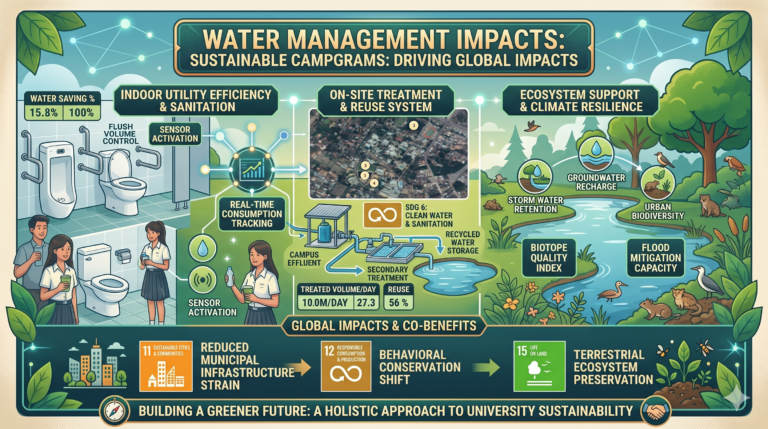
Integrated Impact of Water Management Programs on the SDGs The university’s water management initiatives are driven by a holistic framework. While centered around clean water infrastructure, the program generates cross-cutting impacts that simultaneously support four distinct Sustainable Development Goals (SDGs): [ SDG 6: Clean Water ] │ ┌────────────────────────┼────────────────────────┐ ▼ ▼ ▼ […]
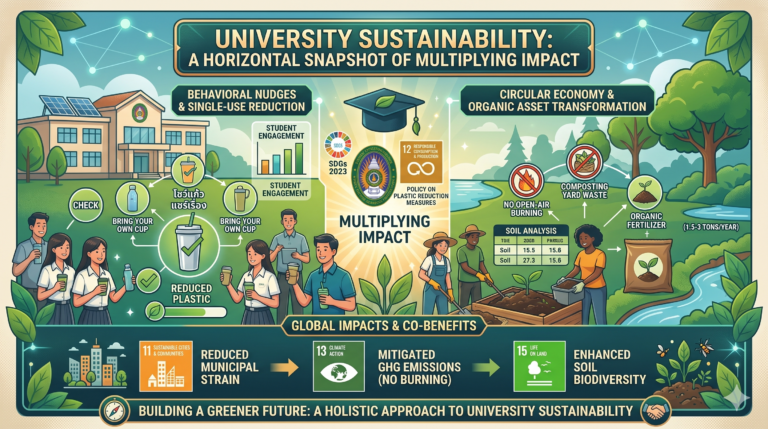
Integrated Impact of Waste Management Programs on the Sustainable Development Goals (SDGs) While the university’s baseline framework originates from SDG 12: Responsible Consumption and Production, the operational practices executed by the Buildings and Vehicles Ground Division demonstrate a powerful, systemic impact that cuts across multiple global goals. ♻️ SDG 12: Responsible Consumption and Production (Core […]